
For manufacturers, direct materials sourcing isn’t just “purchasing.” It’s a core driver for margin, uptime, quality, long-term competitiveness, and cash flow wearing a hard hat. Yet in many mid-market organizations, direct materials decisions still happen reactively: a plant needs parts, a buyer calls the same supplier, pricing gets “tweaked,” and everyone moves on—until the next shortage, premium freight bill, or customer complaint.
Strategic sourcing changes that equation.
When executed well, direct materials strategic sourcing enables manufacturers to reduce costs, improve supplier performance, mitigate supply risk, and build a repeatable process that delivers value year after year. The difference isn’t a fancy slide deck—it’s disciplined execution: knowing where the money is, picking the right battles, running clean sourcing events, and managing suppliers to the right performance metrics.
What Is Direct Materials Strategic Sourcing?
Direct materials strategic sourcing is the structured, deliberate approach to managing the materials that go directly into a manufactured product—raw materials, components, and subassemblies that affect cost, quality, and production continuity.
Unlike indirect procurement, direct materials decisions show up immediately in product cost and gross margin, production uptime, schedule adherence, quality and warranty exposure, and supplier risk.
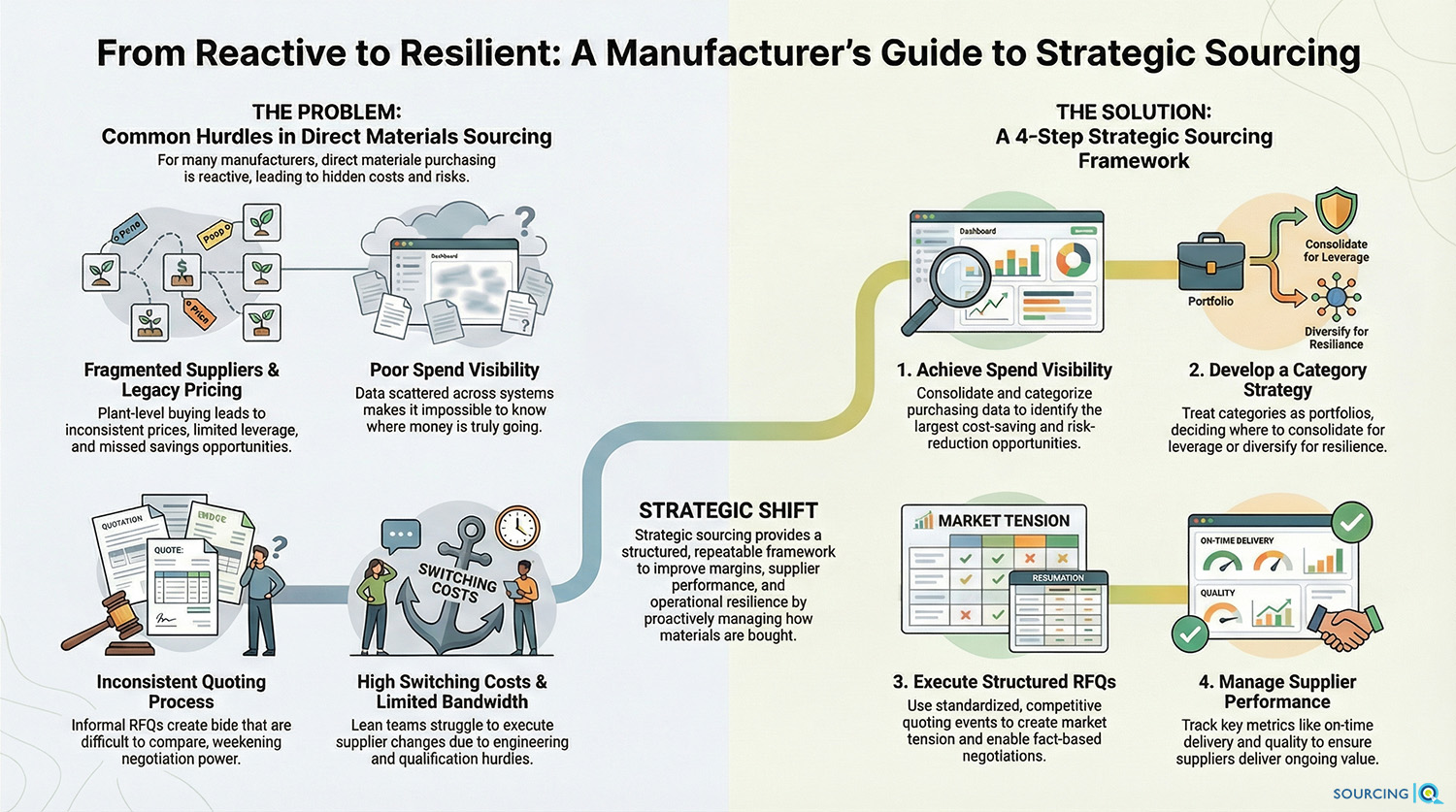
Strategic sourcing goes beyond “getting a better price.” It blends four disciplines:
- Total spend visibility (where the dollars actually go)
- Category strategy (how and where you’ll source, consolidate, diversify, and manage risk)
- Structured RFQs (how you create comparable bids and real market tension)
- Supplier performance management (how you manage the supply base to delivery, quality, and responsiveness metrics)
Most importantly, strategic sourcing is a repeatable operating rhythm, not a one-off cost-down project. Repeatability is how lean teams win.

Most manufacturers know there’s savings in their supply base. Few have a structured plan to capture it. Let’s identify your highest-impact sourcing opportunities.
Why Direct Materials Sourcing Is Different in Manufacturing
Manufacturing environments impose constraints that generic procurement frameworks gloss over. Direct materials sourcing must account for engineering input/approvals, quality requirements, packaging and transportation and phase-in/phase-out strategy and timing.
Production-critical dependencies create asymmetric risk
A late or nonconforming component can shut down a line. That makes “lowest price” a risky compass. The true cost includes downtime exposure, expedited freight, scrap/rework, and customer penalties.
Cost is multi-variable, not one number
Direct materials pricing is shaped by material inputs, tooling, labor content, yield, freight, capacity, and commercial terms. Two quotes can look similar while hiding different assumptions (volume tiers, tooling treatment, surcharge language, lead times, or spec interpretation). Strategic sourcing drives comparability, so negotiations are data-based.
Switching costs and qualification timelines are real
Supplier changes can require FAI/PPAP or other approvals, tooling, validation runs, and engineering bandwidth you may not have. That’s why many “savings opportunities” never become realized: the organization can’t execute the switch.
The right supply base depends on category risk
Some categories benefit from consolidation (leverage and simplicity). Others need redundancy (continuity and resilience). The same company can—and should—do both depending on the failure mode.
Common Direct Materials Sourcing Challenges
Many manufacturers struggle with the same set of challenges, regardless of industry or size.
Fragmented supplier bases
Suppliers accumulate organically—often at the plant level—creating redundancy, inconsistent pricing, and limited leverage.
Legacy pricing and “we’ve always used them”
Long-standing relationships can become barriers to competitive pricing, especially when cost structures change but pricing does not.
Inconsistent RFQ practices
Without structured RFQs, supplier bids become difficult to compare, weakening negotiating leverage and obscuring true market benchmarks.
Limited spend visibility
When spend data is fragmented across ERPs, plants, or part numbers, it becomes difficult to identify where the largest opportunities exist.
Lean teams with limited bandwidth
Mid-market procurement teams are stretched thin, making it difficult to step back and build structured sourcing strategies.
These challenges are common—and solvable with a practical, execution-focused sourcing framework.
A quick example: why “plant-by-plant” buying gets expensive fast
Imagine you run three plants. Each buys machined brackets and housings from local job shops. The parts are similar, but not identical; each plant has its own drawings, its own part numbers, and its own “preferred” supplier. Pricing is “fine” until you map it:
- same alloy, same operations, different prices by double digits
- three lead times, three packaging standards
- no supplier has enough committed volume to invest in fixtures or process improvements
Strategic sourcing doesn’t mean you force everything through one supplier. It means you treat the category as a portfolio: standardize where you can, aggregate volume where it creates leverage, dual source where continuity matters, and then manage performance so the plants actually feel the improvement.
The Core Elements of an Effective Direct Materials Sourcing Strategy
Direct materials strategic sourcing isn’t magic. It’s a sequence of steps that turns purchasing reality into a plan, then into executed outcomes.
Spend visibility and opportunity identification
Every effective sourcing strategy starts with understanding where money is actually being spent.
Manufacturers need category-level visibility that answers: which suppliers account for the majority of spend, where volume is fragmented, and which categories carry the most cost or risk exposure.
A practical approach (even if your data isn’t perfect):
- Normalize supplier names (one supplier shouldn’t appear as five)
- Map parts to categories that match external sourcing markets (machining, moldings, fabrications, electronics)
- Identify “high gravity” categories big enough to matter
Spend visibility lets teams prioritize based on impact, not intuition.
If your business is looking for spend clarity and opportunity sizing, learn more about how SourcingIQ can help here: Spend Assessment
Making spend visibility usable (not perfect)
Most mid-market teams don’t fail at spend analysis because they’re careless. They fail because the data is shaped around accounting, not sourcing. A general ledger view can tell you “we spent $4.2M on steel,” but not which mills or service centers you rely on, how much is tied to one plant vs. shared, or where freight and surcharges are hiding.
A workable spend cube for direct materials usually needs three cuts:
- Supplier view: total spend by supplier, by plant, by category
- Category view: spend by commodity or category
- Program/customer view: where applicable, spend tied to a product line or major customer
Two traps to avoid:
- Counting invoices instead of materials. If you don’t separate raw material from freight, tooling, and service charges, you’ll chase the wrong “savings.”
- Over-granularity. If you build 200 categories, you’ll never execute. Build 20–40 categories that match external sourcing markets, then iterate.
The output should be action-oriented: “These five categories represent the largest addressable opportunity and are feasible to attack in the next 8–12 weeks.”
Category strategy and supplier segmentation
Once spend is visible, categories should be treated as strategic portfolios—not collections of parts.
Effective category strategies define cost reduction vs. risk mitigation priorities, consolidation vs. diversification needs, and supplier roles (strategic, preferred, transactional).
A useful segmentation question is simple: If this supplier misses, what happens?
- If the answer is “line stops,” protect continuity first and negotiate data to improve the cost.
- If the answer is “we can switch quickly,” run competitive events and sharpen the market.
- If the answer is “it’s nuisance spend,” streamline it and stop spending senior time on it.
Not every category benefits from consolidation. Strategic sourcing evaluates where leverage creates value—and where redundancy protects revenue.
Structured RFQs and competitive sourcing events
RFQs are not administrative tasks—they are leverage-building tools.
Well-structured RFQs create comparability, introduce competitive tension, surface cost drivers and assumptions, and enable fact-based negotiations.
The difference between a weak RFQ and a strong one is usually structure:
- clean scope (parts, volumes, delivery location, incoterms and packaging and quality specifications)
- standardized bid fields (tooling, surcharges, lead time, MOQ)
- a serious timeline and clear award logic
Manufacturers that rely on informal quoting or email-based sourcing often leave savings on the table without realizing it.
What good RFQ execution looks like (in the real world)
A direct materials RFQ that drives results usually has five stages:
- Pre-RFQ alignment: confirm volumes, specs/drawings, quality requirements, and qualification gates. If engineering isn’t aligned here, the RFQ will implode later.
- Supplier shortlisting: invite suppliers who are capable and interested. Ten random suppliers create noise; three to five qualified suppliers create leverage.
- Bid package discipline: standardize the inputs (volumes, packaging, incoterms) and the outputs (unit price, tooling, surcharges, MOQ, payment terms).
- Commercial clarification: run a structured Q&A window and reconcile assumptions before “best and final.”
- Award + implementation plan: award is a documented decision with a timeline for ERP updates, tooling/qualification steps, and ramp.
If your RFQ process doesn’t include “award + implement,” you’re running a quoting exercise—not strategic sourcing.
Supplier performance management
Price is only one dimension of supplier value.
Direct materials sourcing strategies should also define expectations for delivery performance, quality metrics, responsiveness, communication, and continuous improvement.
Performance management doesn’t have to be heavy. It does have to be consistent:
- agree on the few metrics that matter (OTD, PPM, NCR response time)
- review on a cadence that matches criticality
- tie performance to decisions (more volume, corrective action, or exit plan)
Supplier performance management without the bureaucracy
Supplier performance programs often fail in mid-market companies for one reason: they try to copy what Fortune 50 companies do. You don’t need a 40-metric dashboard. You need a few leading indicators and the willingness to act.
A practical scorecard for direct materials often includes:
- OTD and schedule adherence
- Quality (PPM / defects / NCRs) and response time
- Lead time reliability (quoted vs. actual)
- Responsiveness (acknowledgment and escalation behavior)
Two simple rules:
- Separate performance from relationship. You can like a supplier and still require improvement.
- Make consequences explicit. Clarity drives action: “If OTD stays below X for two quarters, volume shifts.”
How Strategic Sourcing Drives Direct Materials Cost Reduction
Cost reduction doesn’t come solely from negotiating harder. Strategic sourcing unlocks savings through multiple levers. Here’s the practical manufacturing view of each one:
Volume aggregation
If Plant A and Plant B buy the same commodity separately, you’re paying the “small customer tax” twice. Aggregation improves pricing tiers and gives leverage on terms (freight, payment, VMI/consignment) while simplifying supplier management.
Selective consolidation
Consolidate when you can commit to volume credibly and maintain service. Don’t consolidate categories where switching risk or qualification timelines will wipe out the savings.
Competitive tension and benchmarking
A structured event is how you learn the market. You’re not trying to “win the negotiation.” You’re trying to replace guesswork with facts: where pricing is out of line, where specs drive cost unnecessarily, and which suppliers can perform.
Specification and packaging alignment
This lever often requires engineering/ops partnership, but it’s where large savings hide: standardizing fasteners, aligning resin grades, relaxing unnecessary tolerances, rationalizing packaging. Procurement’s job is to bring the spend and cost-driver data to the table.
Terms and risk-sharing
Unit price matters, but terms shape cash and risk. Better payment terms, clearer surcharge/index language, tooling ownership, lead-time commitments, and warranty obligations keep savings from leaking out later.
Why Execution Is the Missing Link in Many Sourcing Programs
Many manufacturers invest time defining strategies but struggle to realize results because execution breaks down.
Common gaps include: strategies too complex to operationalize, RFQs without discipline or follow-through, savings identified but not captured, and processes dependent on individual heroics.
Execution fails for predictable reasons:
- Award decisions stall. Without clear ownership and timelines, suppliers keep shipping on old pricing.
- Implementation is under-planned. Qualification, tooling, and ERP price updates are where savings go to die.
- Savings aren’t measured. If you can’t tie actions to price, volume, and spec changes, you can’t protect (or prove) the result.
Strategic sourcing only works when embedded into daily operations through repeatable processes, clear ownership, and measurable outcomes.
A realistic execution cadence for lean teams
Mid-market procurement teams don’t have the luxury of year-long transformations. A practical cadence is a rolling wave approach:
- Weeks 1–2: spend visibility refresh + category prioritization
- Weeks 3–6: run 1–2 sourcing events in the highest-impact, most feasible categories
- Weeks 7–10: implement awards, update systems, stabilize supply, validate savings
- Ongoing: supplier performance cadence + next wave selection
This is how you build sourcing capability while delivering near-term results: repeat the cycle, document what works, and get faster every round.
Building Sustainable Direct Materials Sourcing Capability
Long-term value comes from building sourcing capability—not running one-off projects.
Sustainable organizations focus on process discipline, skill development, governance, and documentation/playbooks.
Processes
Define a simple “way we source here”: analyze → plan → execute → implement → manage. Document it so work doesn’t collapse when roles change.
Skills
Buyers need coaching to move from transactional to strategic work: clean bid packages, cost-driver conversations, negotiations that trade concessions for commitments, and supplier performance management.
Governance
Governance is “who decides what.” Without it, plants override awards, specs change without supply impact review, and finance doubts savings. With it, decisions happen faster and savings sticks.
Documentation and playbooks
Templates and playbooks reduce the reinvent-the-wheel tax: RFQ templates, bid scorecards, supplier transition checklists, and performance review agendas. This capability lets manufacturers adapt as markets and supply conditions change.
“Find the money” vs. “keep the money”
One last reality check: direct materials savings is famous for leakage. Prices improve, then creep back up. Plants start spot-buying. Specs drift. Volume commitments evaporate.
A strong program does both:
- Find the money: identify opportunities and execute sourcing events
- Keep the money: lock in process, governance, and performance management so savings persists
That distinction matters even more in private equity environments where the value creation plan expects savings to show up, stay up, and be explainable.
Final Thoughts: Turning Sourcing Strategy Into Results
Direct materials strategic sourcing is one of the most powerful levers manufacturers have to improve margins and operational resilience—but it requires more than intent. It requires structure, discipline, and execution.
Manufacturers that invest in spend visibility, category strategy, structured RFQs, and supplier performance management position themselves to capture meaningful savings while strengthening their supply base.
Strategic sourcing works best when it’s practical, repeatable, and grounded in reality.
Need a menu of practical savings levers? Read Direct Materials Cost Reduction – 12 Levers
Trying to make this repeatable across plants and teams? Read Strategic Sourcing for Manufacturers Playbook