
Most manufacturers have run RFQs. Far fewer feel like they got what they were promised: real savings, clearer decisions, better suppliers, and fewer headaches.
That’s not because competitive sourcing is broken. It’s because RFQs are often treated as a transactional event—send it out, collect quotes, pick the lowest number—rather than an execution discipline that runs from objective-setting through award implementation.
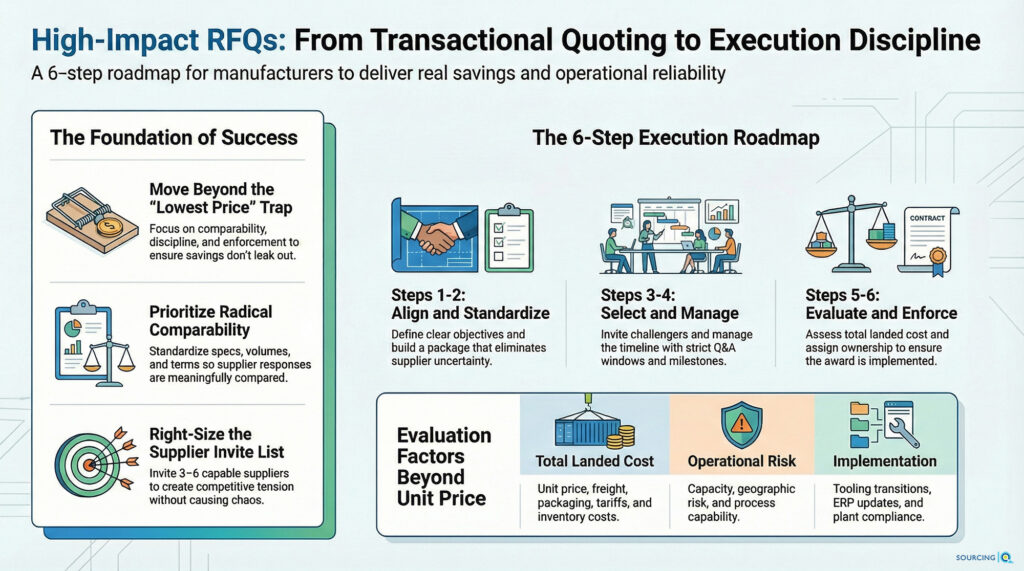
High-impact RFQs create value when they do three things consistently:
- They are built for comparability (so you’re not comparing apples to forklifts)
- They are managed with discipline (so suppliers take them seriously)
- They are implemented and enforced (so savings doesn’t leak back out)
This guide walks through a practical, end-to-end RFQ process for direct materials—focused on structure, repeatability, and follow-through.

The structure of your sourcing event often determines the outcome. We can help maximize supplier competition and commercial results.
Why Most Manufacturing RFQs Underperform
RFQs typically fail for predictable reasons:
1) They launch without a clear objective
If the team can’t answer “What are we trying to optimize—cost, risk, performance, or terms?” the RFQ becomes a confused fishing expedition. You get lots of numbers and very little decision clarity.
2) Supplier responses aren’t truly comparable
Different assumptions produce different prices. When volume tiers, incoterms, packaging, quality gates, lead times, or tooling treatment aren’t standardized, bid comparisons become meaningless—and negotiations turn into guesswork.
3) Awards aren’t executed or enforced
This is the quiet killer. Teams do the hard work, pick a supplier, and then the business keeps buying the old way because implementation wasn’t planned, systems weren’t updated, or plants weren’t aligned. The spreadsheet shows savings. Actual spend does not.
An RFQ doesn’t “work” because you sent it. It works because you ran it cleanly and then made the outcome real.
Step 1 — Define the RFQ Objective
Before you write a single line of the bid package, define what “success” means.
Common RFQ objectives include:
- Reduce unit cost (and reset market pricing)
- Improve supply reliability (delivery, lead-time stability, responsiveness)
- Mitigate risk (dual-source, capacity redundancy, geographic diversification)
- Reset commercial terms (freight, indexing language, payment terms, tooling ownership)
Here’s the key: an RFQ designed for cost reduction looks different than one designed for continuity.
If the objective is ambiguous, the outcome will be ambiguous.
Practical move: write a 1–2 sentence objective and get alignment from procurement + operations (and engineering when specs/qualification are involved). If you can’t align the objective internally, suppliers won’t save you.
Step 2 — Build a Comparable RFQ Package
Comparability is the foundation. Most “bad RFQs” fail here.
A strong RFQ package standardizes inputs so supplier responses can be meaningfully compared. At minimum, define:
Scope and specifications
- Drawings/specs with revision control
- Quality requirements and validation gates
- Any required certifications or process constraints
Demand and volumes
- Historical volumes (if available)
- Forecast assumptions (with uncertainty noted)
- Program/plant breakdowns if sourcing differs by location
Logistics expectations
- Incoterms / freight responsibility
- Packaging requirements
- Delivery cadence (line-side, weekly, monthly, etc.)
Commercial terms
- Payment terms expectation
- Tooling treatment (quoted separately vs amortized)
- Surcharge/indexing requirements (define the rules, not just “market-based”)
- Minimum order quantities / lot sizes
Why this matters: suppliers will price uncertainty. If you leave assumptions open, suppliers will fill the gap—and you’ll spend the back half of the RFQ arguing about what the quote “meant.”
A comparable RFQ package doesn’t reduce supplier flexibility—it reduces misunderstanding.
Step 3 — Select the Right Supplier Set
More suppliers doesn’t automatically mean better outcomes. In manufacturing, having too many suppliers often creates noise, delays, and low-quality responses.
A good supplier set creates competitive tension without chaos.
Start with capability, not convenience
Invite suppliers who can actually meet your technical, quality, and capacity constraints. A supplier who can’t meet the requirements will either:
- not respond, or
- respond with hedged pricing and long lead times, or
- promise what they can’t deliver (which becomes your future problem)
Include incumbents and credible challengers
- Incumbents provide baseline pricing, continuity, and performance context.
- Challengers introduce market pressure and options.
Right-size the invite list
As a practical range for direct materials categories: 3–6 suppliers is often enough to create tension while still allowing rigorous evaluation and follow-up. If you invite 12 suppliers and can’t manage the process tightly, you’re not running competition—you’re running a spam campaign.
Step 4 — Manage the RFQ Process Actively
RFQs should be managed like a project, not launched like a memo.
Active management improves response quality and prevents last-minute chaos.
Establish a clear timeline and milestones
- RFQ release date
- Supplier Q&A window
- Bid due date (with rules for late submissions)
- Clarification window
- Best-and-final (if applicable)
- Award date
Run structured clarifications
Suppliers will have questions. That’s normal. What matters is discipline:
- answer questions consistently (avoid side deals and side emails)
- document clarifications and share with all suppliers where appropriate
- confirm assumptions before you evaluate pricing
Enforce submission requirements
If the bid template asks for tooling, lead time, MOQ, and indexing language—and a supplier ignores half of it—don’t “interpret generously.” Missing data is a signal. Either follow up immediately or treat the bid as incomplete.
The goal is simple: complete bids with consistent assumptions. That’s what creates leverage and decision clarity.
Step 5 — Evaluate Responses Holistically
High-impact RFQs are not evaluated on unit price alone—especially in direct materials.
A manufacturer-grade evaluation considers:
Total landed cost
Unit price + freight + packaging + tariffs/duties (if applicable) + inventory implications.
Performance and capability
- quality performance expectations
- process capability (can they hold the tolerances consistently?)
- lead-time reliability (quoted vs actual behavior, if known)
Capacity and scalability
Can they support your ramp? Can they handle seasonality? What happens if you need 20% more volume?
Risk and resilience
Single-site risk, geographic risk, capacity constraints, supplier financial stability, and the practicality of dual-sourcing.
The point isn’t to “overthink” it. The point is to avoid buying yourself an operational problem in exchange for a small unit-price win.
Step 6 — Execute and Enforce the Award
This is the step most RFQs quietly skip—and it’s why savings tend to evaporate.
An RFQ is only successful when the award is implemented and defended.
Build an implementation plan before you award
- transition timeline (tooling, validation, ramp)
- plant cutover plan (who changes what, when)
- ERP and pricing updates
- inventory strategy during transition (avoid double-buying and panic buying)
Assign ownership
If “everyone” owns implementation, no one does. Assign a clear owner for:
- supplier transition
- internal system updates
- plant rollout and compliance
Establish governance and compliance
Savings leakage typically happens because plants revert to familiar suppliers or “exceptions” become routine. Governance doesn’t have to be heavy—but it must exist:
- define when exceptions are allowed
- define approval paths
- track compliance at the supplier/category level
If you don’t enforce awards, you’re not running strategic sourcing—you’re running a quoting hobby.
RFQs Work When They’re Treated as a Process
Direct materials RFQs are one of the most powerful execution tools manufacturers have—when they’re structured for comparability and managed with discipline end-to-end.
When RFQs are aligned to strategy, built with clean assumptions, evaluated holistically, and implemented with governance, they produce:
- more consistent cost outcomes
- better supplier performance
- higher confidence in sourcing decisions
- fewer “we saved money but operations hates it” outcomes