
In PE-backed manufacturing companies, the first 100 days set the tone for operational value creation, making it critical to have a 100-day procurement plan. The window is narrow, the expectations are high, and the decisions made early tend to define what’s possible later.
Procurement is one of the fastest paths to early impact. Direct materials represent a large share of cost structure, and even modest improvements in sourcing discipline can produce measurable EBITDA gains without requiring revenue growth or capital investment.
The problem isn’t lack of motivation. Most operating partners and COOs understand the opportunity. The problem is sequencing.
Organizations that jump straight to sourcing events before establishing visibility get unreliable results. Teams that try to fix everything at once fix nothing. Plants that aren’t brought along appropriately find workarounds and keep buying the old way.
The difference between limited procurement impact and meaningful value creation in the first 100 days is rarely effort. It’s order.
Days 0–30: Establish Visibility and Control
The job in the first 30 days is to understand the system before touching it. Every hour spent trying to run sourcing events without spend clarity is an hour spent with incomplete information — and incomplete information produces avoidable mistakes.
What this phase actually involves:
Consolidate procurement data across all plants and ERP systems. Don’t assume the data is clean or consistent — it almost never is. Supplier names will appear in multiple formats. Categories will be coded differently by facility. Address that before analysis begins, not during it.
Map the supplier base at a high level: who supplies what, at what volume, and to which plants. This is your first picture of where purchasing is concentrated and where it’s fragmented.
Identify the highest-spend suppliers and major direct materials categories. You need to know what’s worth paying attention to before you can prioritize.
Flag supply risks early. Single-source suppliers for production-critical components, long lead-time categories, capacity-constrained vendors, and geographically concentrated supply are all risks that can derail integration momentum if they surface unexpectedly later.
This phase is not about making changes. It’s about earning the right to make informed changes.
What good looks like at Day 30: A baseline view of procurement structure, a unified supplier list, a category-level spend picture, and a documented risk map. No surprises yet — by design.

We help PE sponsors and operators quickly identify priorities, savings opportunities, and execution plans.
Days 30–60: Identify and Prioritize Opportunities
With visibility established, the focus shifts from understanding to insight — translating procurement data into a prioritized opportunity pipeline.
Look for the patterns that signal value:
Supplier fragmentation. Multiple suppliers in a category that could support fewer, often accumulated through plant-level autonomy and organic growth. Fragmentation means split volume, split leverage, and split attention.
Cross-plant price variation. The same or similar component purchased at meaningfully different prices across facilities. This is almost always present in decentralized manufacturing organizations, and it’s often the fastest opportunity to close.
Categories without recent competitive sourcing. Legacy supplier relationships where pricing hasn’t been tested against the market in two or more years. Markets change. Supplier cost structures change. Static pricing doesn’t.
Contract expirations and renewal windows. Upcoming renewals are natural action points — use them proactively rather than reactively.
Build a sourcing opportunity pipeline from these signals. Size each opportunity roughly, assess feasibility (qualification requirements, switching risk, specification complexity), and sequence by impact and executability — not just spend magnitude. The largest category isn’t always the right first move.
What good looks like at Day 60: A prioritized pipeline of three to five sourcing initiatives with realistic savings estimates, clear sequencing logic, and defined next steps for each.
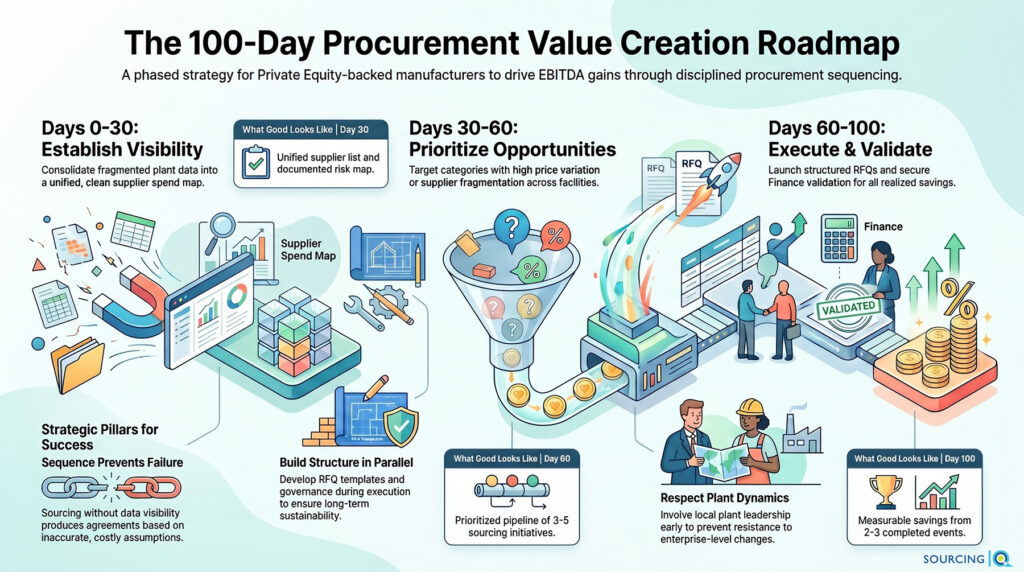
Days 60–100: Execute Early Sourcing Initiatives
This is where the value gets captured — and where procurement credibility gets built or lost.
Launch structured RFQs for the highest-priority, most executable categories. “Structured” is the operative word: clear scope, standardized bid formats, pre-defined evaluation criteria, and a real award-and-implementation process. An email asking for updated pricing isn’t a sourcing event. It’s a gesture.
In parallel, capture the lower-effort wins that don’t require a full RFQ:
- Consolidate obvious supplier overlaps in low-risk categories where switching isn’t complex
- Align pricing across plants for common components where cross-plant variation was identified
- Renegotiate key supplier agreements where contracts are expiring or pricing is clearly out of market
Document savings as they’re realized, tied to specific actions and baseline pricing. Finance needs to validate what procurement claims — and credibility built through rigorous savings documentation in the first 100 days compounds throughout the hold period.
Communicate results to leadership. Early wins don’t just deliver value — they establish procurement’s role in the value creation story.
What good looks like at Day 100: Measurable cost savings from two to three completed sourcing initiatives, a validated pipeline of opportunities in progress, and leadership confidence in procurement as a strategic function.
Parallel Track: Build Procurement Structure Alongside Execution
One of the most common sequencing mistakes is waiting until sourcing is “done” to build the operating infrastructure. By then, the quick-win momentum has passed, and the organization has already formed habits around the old model.
Structure should evolve alongside execution:
Standardized RFQ templates. The first sourcing events inform what good looks like. Capture that in a reusable format so subsequent events don’t start from scratch.
Procurement governance and decision rights. Who approves category awards? How are exceptions handled? Which decisions belong at the plant level versus enterprise level? Ambiguity here produces inconsistency — and inconsistency is how savings leaks.
Category ownership. Someone should be accountable for each major spend area, with clear responsibility for strategy, execution, and performance management.
Reporting cadence. Consistent visibility into spend, savings, and supplier performance keeps procurement connected to the business and prevents the function from drifting back toward reactive mode.
This structural work isn’t glamorous. It’s what determines whether the savings realized in the first 100 days are still showing up in Year 3.
Common Mistakes in the First 100 Days
Even well-resourced integration teams make the same avoidable errors:
Launching sourcing events before spend visibility is established. The instinct to move fast is right. The sequence is wrong. Sourcing without data produces agreements based on assumptions that may not hold.
Trying to move on too many categories at once. Spread thin, execution suffers everywhere. Two sourcing events done well produce more value than six done poorly.
Ignoring plant-level dynamics. Plants that have managed their own sourcing for years will have concerns about enterprise decisions overriding local knowledge. Those concerns aren’t always wrong. Move with operational awareness, not over it.
Overestimating how quickly synergies materialize. Procurement synergies are real but conditional — they depend on category overlap, specification comparability, and execution discipline. Build conservative assumptions into the plan and let results exceed them.
Treating savings capture as the finish line. Negotiated savings that aren’t implemented in ERP, enforced through governance, and defended against compliance drift don’t persist. Implementation and enforcement are part of the work, not the epilogue.
Momentum Creates Procurement Value
The first 100 days matter disproportionately — not because procurement transformation is complete by Day 100, but because the foundation built in that window determines the trajectory of everything that follows.
Organizations that establish visibility, identify opportunities systematically, execute disciplined sourcing events, and build structural discipline in parallel create momentum that compounds. Each sourcing cycle gets faster. Each category becomes a template for the next. The procurement function earns credibility that makes future initiatives easier to execute.
In PE-backed manufacturing environments, that trajectory matters. Value creation timelines are compressed. Operating partners need procurement to perform as a strategic lever — not a support function catching up.
The 100-day procurement plan is what makes that possible. Not more effort in a worse order, but the right actions at the right time building toward something durable.