
Private equity value creation gets a lot of attention in the right places: revenue growth, pricing strategy, operational efficiency, working capital improvement. These are the levers that show up in every operating plan and every board deck.
Procurement usually doesn’t make that list — not because it isn’t significant, but because it rarely gets approached with the same strategic rigor. In most manufacturing portfolio companies, purchasing runs on autopilot: same suppliers, same pricing, same informal processes that worked when the company was smaller and margins were wider.
That’s a problem. In manufacturing environments, direct materials typically represent 40–70% of total cost structure. A 3–5% improvement in direct materials costs drops directly to EBITDA — no new revenue required, no capital investment, no market dependency. It’s one of the fastest, most controllable margin levers available in an industrial business.
For PE firms and operating partners who want repeatable operational improvement across a portfolio, procurement isn’t a back-office function. It’s a value creation engine that most portfolio companies haven’t turned on yet.
Why Procurement Is Usually Underdeveloped in Portfolio Companies
The procurement gaps in most PE-backed manufacturers aren’t the result of negligence. They’re the result of growth.
Companies that grow organically — or through acquisition — develop purchasing habits that serve the moment rather than the strategy. Plants build their own supplier relationships. Buyers solve problems locally. The supply base accumulates over time without anyone stepping back to ask whether the current structure is the right one.
By the time a PE firm acquires the business, what typically exists is:
Decentralized purchasing. Individual plants negotiate independently. Volume that could create enterprise leverage gets fragmented across facilities, each operating as a small customer rather than part of a larger buying entity.
Legacy supplier relationships. Suppliers selected years or decades ago continue supplying without periodic market testing. Pricing that made sense in a different cost environment persists because no one has challenged it.
Limited spend visibility. Purchasing data exists — usually in abundance — but it lives across multiple ERP systems, with inconsistent supplier naming and category structures that reflect accounting logic rather than procurement strategy. You can’t manage what you can’t see.
No structured category management. Procurement functions primarily as order administration: process the PO, expedite when necessary, move on. Category strategy, sourcing events, and supplier performance management often don’t exist in any formal sense.
The result is a purchasing function that keeps production running but leaves significant margin on the table. For a PE operating partner, these gaps aren’t problems — they’re opportunities.

Procurement is often one of the fastest paths to EBITDA improvement. Discover how sourcing can support your investment thesis.
The Procurement Value-Creation Opportunity
Understanding where procurement value actually comes from is important, because it’s not just about negotiating harder.
The most meaningful procurement improvements in portfolio companies typically come from four sources:
Supplier consolidation and volume aggregation. When multiple plants are buying similar materials independently, they’re paying a fragmented buyer’s price. Aggregating volume across the enterprise — where the supply market supports it — creates pricing leverage and simplifies supplier management. This is often the fastest, least disruptive lever available.
Competitive sourcing where markets support it. Many categories in portfolio companies haven’t seen a structured RFQ in years. Legacy suppliers aren’t under competitive pressure, so pricing hasn’t moved with the market. Running disciplined sourcing events doesn’t just reduce cost — it reestablishes a market-based pricing relationship that persists beyond the initial event.
Spend visibility and category prioritization. Not every category deserves the same effort. Procurement value comes from focusing on the categories that matter most: high spend, competitive supplier markets, feasible execution. Without structured spend analysis, teams default to urgency rather than impact.
Supplier performance management. Price is one dimension of supplier value. In manufacturing, delivery reliability, quality performance, and responsiveness directly affect production costs and customer outcomes. Building performance expectations into supplier relationships — not just pricing — captures a dimension of value that pure cost-down programs miss.
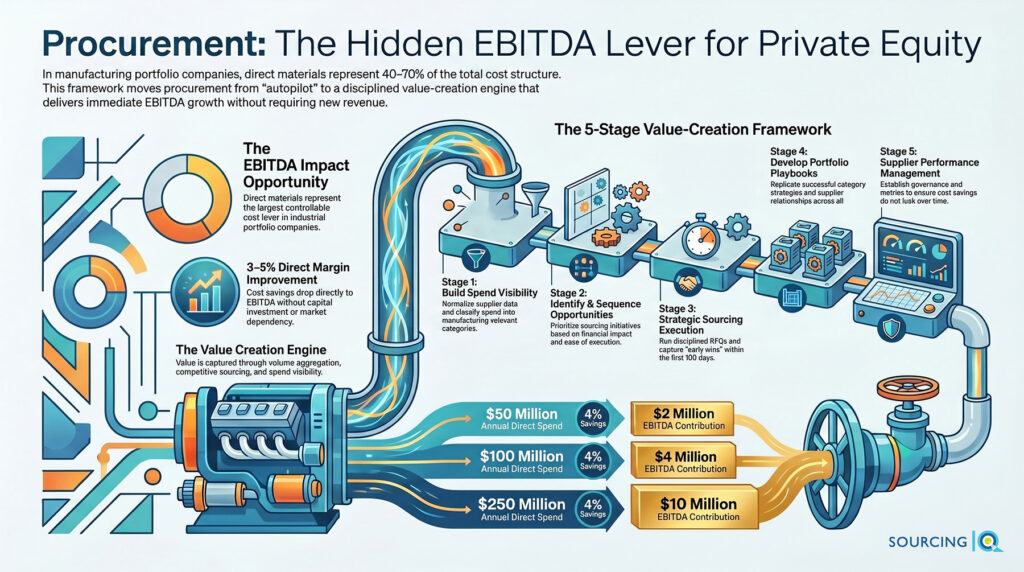
Even modest improvements compound quickly when direct materials represent a significant share of cost structure. A business with $50M in annual direct materials spend that captures 4% savings isn’t just saving $2M — it’s adding $2M to EBITDA, which translates to meaningful multiple expansion at exit.
A Procurement Value-Creation Framework for PE Portfolios
Turning procurement from a transactional function into a value-creation engine requires more than a series of one-off sourcing projects. It requires a structured framework that can be applied systematically — and replicated across portfolio companies.
Here’s how that framework typically unfolds:
Stage 1: Spend Visibility
You can’t prioritize what you can’t see. The first step is building a clear picture of how direct materials spending is distributed — across suppliers, categories, and plants simultaneously.
This means normalizing supplier data, classifying spend into manufacturing-relevant categories (not accounting codes), and creating a cross-plant view of purchasing activity. What typically surfaces: supplier concentration that wasn’t visible at the plant level, categories that are large enough to matter but haven’t been strategically managed, and pricing variation across sites that signals immediate opportunity.
The output of this stage isn’t a report — it’s a prioritized opportunity pipeline.
Stage 2: Opportunity Identification
With spend visible, procurement leaders can diagnose where structural inefficiencies exist and what they’re worth.
Common signals: fragmented supplier bases in consolidatable categories, cross-plant price variation on identical materials, categories with static pricing and no recent competitive benchmarking, and long-tail supplier relationships that create administrative complexity without proportional value.
Each signal maps to a potential sourcing initiative. The goal of this stage is to size and sequence those initiatives — prioritizing by impact and feasibility, not just spend magnitude.
Stage 3: Strategic Sourcing Execution
Opportunity identification is analysis. This is where the value gets captured.
Structured sourcing execution means building category strategies, running competitive RFQs that create genuine comparability, evaluating suppliers holistically (not just on unit price), and implementing awards with the governance discipline that prevents savings from leaking back out.
In PE-backed environments, execution speed matters. Operating partners typically want to see early wins in the first 100 days — both to validate the opportunity and to create organizational momentum. The most feasible high-impact categories often produce savings within one quarter of a structured sourcing event.
Stage 4: Portfolio Procurement Playbooks
One of the structural advantages PE firms have over independent operators is the ability to replicate what works.
Procurement strategies developed within one portfolio company can often be adapted and deployed in other companies operating in similar industrial sectors. Supplier relationships established at one portfolio company may benefit others. Category strategies that produced results in one business create a starting framework for the next.
Developing repeatable sourcing playbooks across the portfolio turns procurement improvement from a one-company initiative into a systematic operating capability. Over time, this becomes a durable competitive advantage: the ability to rapidly stand up procurement discipline in any newly acquired industrial business.
Stage 5: Supplier Performance Management
Procurement gains that aren’t institutionalized eventually erode. Prices creep back up. Plants revert to familiar suppliers. Compliance to sourcing decisions weakens as urgency takes over.
Sustainable procurement improvement requires ongoing supplier performance management: defined metrics, a review cadence, clear escalation paths, and governance that makes compliance easier than exception. This isn’t bureaucracy — it’s what separates a one-time cost reduction from a durable margin improvement.
Procurement in the First 100 Days
Early in PE ownership, procurement improvement typically starts with diagnostic work rather than execution. The first 100 days should focus on building the analytical foundation and identifying where to act first.
Practical early priorities:
- Map the supplier base: who supplies what, at what volume, across which plants
- Build spend visibility: normalize the data, classify categories, identify cross-plant patterns
- Diagnose the gaps: which categories are fragmented, untested, or priced above market?
- Build the opportunity pipeline: size and sequence initiatives by impact and feasibility
- Launch 1–2 sourcing events in the highest-impact, most executable categories to demonstrate value
The first sourcing initiatives aren’t just about the savings — they’re about establishing proof of concept and organizational credibility for the broader procurement program that follows.
Scaling Procurement Across the Portfolio
The arithmetic of portfolio procurement is compelling. Operating partners who identify procurement as a value creation lever in one business often discover similar opportunities across others.
Multiple portfolio companies may be purchasing overlapping categories from the same supplier base — often without awareness of each other’s contracts. Coordinating sourcing efforts across companies can increase purchasing leverage, introduce new supplier relationships, and spread the fixed costs of procurement expertise across a wider base of spend.
This doesn’t require a centralized procurement function to work. It requires operating partners who recognize procurement as a lever and portfolio companies with enough category overlap to create shared sourcing opportunities.
For PE firms investing in industrial manufacturing businesses, a systematic approach to procurement can evolve from a company-specific improvement initiative into a portfolio-wide operational playbook — one that gets faster and more effective with each deployment.
Procurement as a Portfolio Value Engine
In manufacturing businesses, procurement is often one of the largest controllable levers available to a PE owner. It doesn’t require market growth. It doesn’t require capital investment. It doesn’t depend on hiring new talent. It requires structure, analytical discipline, and execution capability — and it produces measurable EBITDA improvement that compounds with scale.
Portfolio companies that enter ownership with underdeveloped procurement functions aren’t behind — they’re candidates for one of the most reliable value creation plays in industrial private equity.
When approached through a structured framework, procurement stops being a purchasing function and starts being a strategic asset.