
Most manufacturers might not choose to source direct materials reactively. They get there the honest way: supplier fires, price increases, shortages, expediting, and a plant that (understandably) cares more about keeping the line running than building a beautiful sourcing process. The result is familiar—legacy suppliers, informal negotiations, and plant-by-plant buying that keeps production moving but rarely produces sustained savings or better supplier performance.
A direct materials sourcing strategy is the antidote. Not a PowerPoint strategy—a workable strategy that is execution-focused, data-informed, and built for manufacturing reality instead of generic procurement playbooks.
Below is a practical framework you can apply with a lean team of almost any size.
What Makes Direct Materials Sourcing Strategic?
Strategic sourcing isn’t “run an RFQ once in a while” or “renegotiate when prices spike.” In manufacturing, it’s making deliberate decisions about how you source direct materials, from whom, and under what operating and commercial conditions.
A direct materials sourcing strategy does a few specific things:
- Aligns sourcing decisions to business and production priorities
- Focuses on categories (families of spend), not individual parts
- Balances cost, risk, quality, and continuity of supply
- Is repeatable and measurable over time
If your strategy can’t survive a busy quarter, it’s not a strategy—it’s a wish list. Here’s what we recommend to our clients when it comes to building a direct materials sourcing strategy.
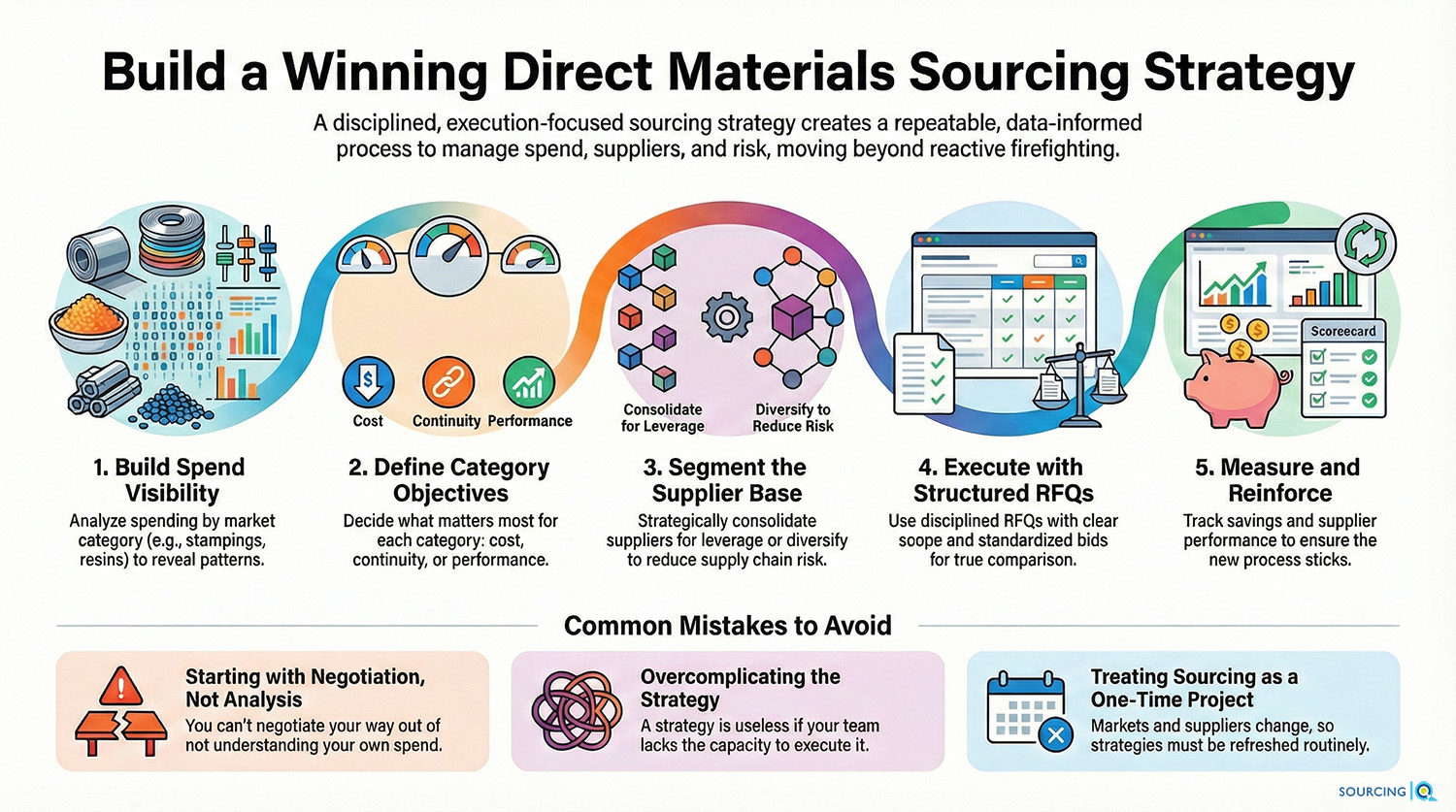
Step 1 — Build Spend Visibility at the Category Level
Every effective strategy starts with knowing where the money is actually going. It sounds obvious, yet most teams have transactional data and still lack real visibility into spend patterns because line-item reports don’t show the story.
Category-level visibility should answer:
- Total spend by category and supplier
- Where volume is fragmented across suppliers
- Concentration risk and leverage points
- Which categories carry the biggest cost or risk exposure
What “category-level” looks like in the real world
In direct materials, categories should match the external sourcing market —not internal-facing categories for engineering or production and not accounting codes. Think: machined components, injection molded parts, stampings, castings, resins, steel, electronics, packaging. Once you group spend that way, patterns show up fast: duplicate suppliers across plants, wildly different prices for similar work, and categories that are big enough to matter.
Good enough beats perfect.
Don’t drive yourself mad trying to get flawless numbers. Start with something actionable: “These 3–5 categories are where we can realistically drive impact in the next 60–90 days.”
Step 2 — Define Category Objectives and Constraints
Not all categories should be sourced the same way. Each direct materials category has its own cost drivers, supply risks, and constraints.
For each category, define:
- Cost reduction vs. risk mitigation priorities
- Quality and performance requirements
- Lead time and capacity constraints
- Single-source vs. multi-source approach
The tradeoff most teams avoid (and should stop avoiding)
A strategy forces clarity on the uncomfortable question: What matters most here—cost, continuity, or performance? That context is critical to your decision-making and reporting.
Example:
- A highly engineered component with limited qualified suppliers may prioritize continuity and performance (and negotiate using cost-driver logic rather than blunt price pressure).
- A commodity material with real competition may be ideal for competitive sourcing, volume aggregation, and consolidation.
If you don’t define objectives, you default to the same play every time: “push price.” That’s how you “save” 3% and lose 30 hours of production.
Step 3 — Segment and Rationalize the Supplier Base
Supplier segmentation is where strategy becomes leverage. Over time, suppliers will accumulate organically (often at the plant level), creating duplication, inconsistent pricing, and limited negotiating power.
A structured approach evaluates where consolidation creates value and where diversification reduces risk.
When consolidation creates leverage
Consolidate when:
- There’s real competition (multiple capable suppliers)
- You can credibly shift volume
- Standardization is feasible (specs, packaging, terms)
- The operational risk of change is manageable
Consolidation isn’t about “fewer suppliers” for its own sake—it’s about aligning the supply base to category objectives.
When diversification is smarter
Diversify (or keep dual sources) when:
- A failure means an extended line shutdown
- Qualification timelines are long and resource-heavy
- Capacity is tight or volatile
- Geography, logistics, or single-point-of-failure risk is high
A simple filter: If a supplier misses, do you have a workaround… or a shutdown? Your sourcing strategy should look different depending on that answer.
Step 4 — Use Structured RFQs to Execute the Strategy
RFQs are not a strategy. They’re the execution mechanism. A good RFQ process creates comparability, introduces competitive tension, benchmarks the market, and surfaces cost drivers and assumptions.
The fastest way to kill leverage is in the classic email RFQ:
- unclear scope
- inconsistent inputs
- apples-to-oranges bids
- “we think we can do it” quotes that explode after award
What a disciplined RFQ includes
You don’t need fancy tools to run a better RFQ. You need structure:
- Clear scope: parts, volumes, quality requirements, specifications, delivery destination, incoterms, packaging requirements
- Standardized bid fields: unit price, tooling, MOQs, lead times, surcharges/indexing, payment terms
- A real timeline: Q&A window, bid due date, BAFO (best-and-final) cadence
- Comparable assumptions: reconcile interpretation before negotiating
- Award logic: define what “best value” means for the category (cost vs risk vs performance)
RFQs should be built to support the category strategy—not to create busywork.
Step 5 — Measure Results and Reinforce the Process
If you don’t measure outcomes, you don’t have a strategy—you have a burst of random activity.
Effective teams track:
- Savings realized vs. identified
- Supplier performance (delivery, quality, responsiveness)
- Compliance to sourcing processes
- Progress against category objectives
The difference between “finding” savings and “keeping” savings
Savings leakage is real. It happens when:
- awards aren’t implemented cleanly
- pricing isn’t updated in systems
- plants keep buying “the old way”
- suppliers creep price back up via surcharges/terms
- volumes shift and invalidate assumptions
Reinforcement is how savings sticks:
- simple governance (who decides, who executes, who approves exceptions)
- basic templates/playbooks so the team doesn’t reinvent the wheel
- a recurring cadence to review supplier performance and category progress
This is how execution discipline becomes normal—not heroic.
Common Mistakes to Avoid When Building a Sourcing Strategy
Even smart teams blow this—usually in predictable ways.
1) Starting with negotiation instead of analysis
Without spend visibility and category insight, negotiations are reactive and capped in impact.
You can’t negotiate your way out of not understanding your own spend. Anchor your negotiations in your actual numbers, not hopeful figures.
2) Overcomplicating the strategy
Complex frameworks that can’t be executed consistently fail—especially in lean organizations.
If your “strategy” requires a new team, three new systems, and perfect data… it’s basically fan fiction. Implement strategies that are easy to hand off.
3) Treating sourcing as a one-time exercise
Markets change, volumes shift, suppliers evolve. Strategies must be routinely revisited and refreshed.
4) Ignoring execution capacity
A strategy must match your ability to execute. Simplicity and discipline often outperform sophistication.
Final Thoughts: Strategy Only Works If It Gets Executed
Building a direct materials sourcing strategy doesn’t require a huge team or complex systems. It requires clarity, prioritization, and disciplined execution.
If you want a simple way to start, do this:
- Get category-level spend visibility
- Pick 2–3 categories with real impact and feasible execution
- Define objectives and constraints
- Run disciplined RFQs aligned to the strategy
- Track results and tighten the process
That’s how manufacturers reduce costs, improve suppliers, and avoid living in a permanent sourcing fire drill.
Pressure test your assumptions – Read Procurement Challenges in Manufacturing
Need a team-wide uplift? Learn more about SourcingIQ’s training