
In procurement, RFQ and RFP get used interchangeably all the time. In manufacturing, that’s a problem.
They’re not the same document. They’re not interchangeable tools. And using the wrong one doesn’t just create confusion — it actively weakens your sourcing outcomes before the first supplier responds.
In direct materials environments, where specifications, tolerances, and commercial precision are the whole game, the distinction matters. Here’s the best way to think about it.
What an RFQ Is in Manufacturing
An RFQ — Request for Quotation — is a structured pricing document issued when the requirement is already defined.
You know what you need. You have drawings. You have specs. You have volume assumptions. What you’re asking suppliers to do is quote against a common, controlled set of inputs so you can compare their responses on equal footing.
In direct materials sourcing, RFQs are the dominant tool because:
- Parts are defined by engineering drawings and tolerances
- Multiple suppliers can produce to the same spec
- The primary objective is structured price comparison
- Comparability is what creates leverage
A strong direct materials RFQ includes technical documentation, volume assumptions, commercial terms, and a standardized supplier response template — so every bid comes back in the same format and can be evaluated against the same criteria. That’s the whole point.
When specs are locked and supplier capabilities are comparable, the RFQ is designed to let the market speak clearly.
What an RFP Is in Manufacturing
An RFP — Request for Proposal — is a different animal. It’s used when the solution isn’t fully defined and you need suppliers to propose an approach.
Instead of “here’s exactly what we need, please quote it,” an RFP says “here’s our problem or objective, tell us how you’d solve it.”
In manufacturing environments, RFPs show up most often for:
- Professional or managed services
- Technology implementations (ERP, analytics platforms, sourcing tools)
- Outsourced operations or complex capability decisions
- Logistics providers or contract manufacturing evaluation
In these cases, supplier responses will vary in structure, methodology, and scope — because the “solution” isn’t predetermined. The evaluation is necessarily broader and more qualitative. You’re comparing approaches, not identical parts.
That’s appropriate when approaches legitimately differ. It becomes a problem when it’s applied where it doesn’t belong.
When to Use an RFQ
Use an RFQ when the specification is the answer to “what are we sourcing?”
If you can answer yes to these, you’re in RFQ territory:
- Technical specs and drawings are finalized
- Multiple suppliers can produce the part or material
- You want standardized, comparable price responses
- The primary evaluation criterion is cost, lead time, and performance — not methodology
Direct materials categories almost always belong here. Machined components, stamped parts, castings, resins, subassemblies, packaging — if the part is defined, structure the process around an RFQ.
The goal is comparability. Comparability is leverage.
When to Use an RFP
Use an RFP when you need suppliers to tell you how they’d do something — not just what they’d charge.
That applies when:
- The scope or solution isn’t defined enough to price directly
- You’re evaluating a service provider’s capabilities, methodology, or team
- You’re selecting a platform or outsourced function
- Non-price factors (implementation approach, risk management, service model) are genuinely material to the decision
The key signal: if you can’t build a standardized pricing template because the “product” doesn’t have a fixed spec, you’re likely in RFP territory.
For direct materials? That’s rarely where you land.
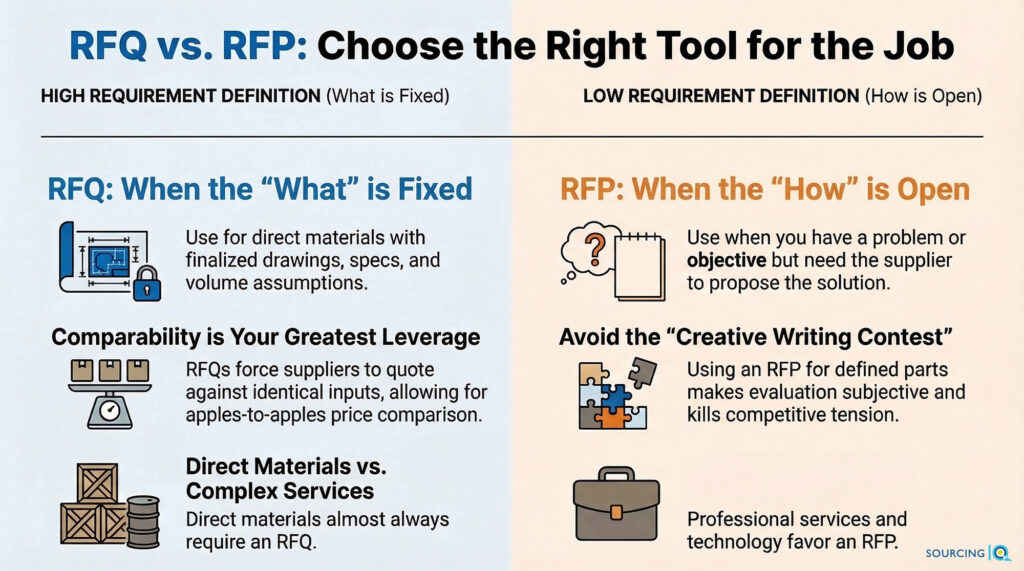
The Cost of Using the Wrong Tool
This is where it can get you in trouble.
If you use an RFP for a well-defined direct materials category:
Suppliers will respond in their own formats. Pricing structures won’t match. Evaluation becomes subjective. Competitive tension dissolves because you’re no longer comparing the same thing. You’ve turned a structured sourcing event into a creative writing contest — and the supplier who writes best might not be the one who should win.
If you use an RFQ for a complex service or undefined scope:
You’ll artificially constrain responses that need flexibility. Important qualitative factors — implementation risk, service model, integration complexity — get flattened into a price column where they don’t belong. The lowest number wins for the wrong reasons.
Process precision isn’t bureaucracy. It’s what prevents avoidable mistakes from compounding across an engagement.
Why RFQs Dominate in Direct Materials
Manufacturing sourcing is specification-driven by nature. Engineering drawings, material grades, tolerances, quality requirements — these exist because the part has to perform in a production environment.
When those inputs are clear and controlled, RFQs give procurement a structural advantage:
- Supplier responses are standardized and comparable
- Evaluation criteria can be pre-defined and documented
- Award logic is defensible
- The process is repeatable across categories, plants, and sourcing cycles
That repeatability matters even more in multi-plant environments and PE-backed organizations where sourcing discipline has to scale — and where “we made a decision” needs to be traceable to something more than a gut call.
RFPs have a legitimate role in manufacturing procurement. It’s just a narrower one than most teams assume.
Clarity in Process Creates Leverage
The RFQ vs RFP question comes down to one thing: how defined is the requirement?
If the product is defined, use an RFQ. If the solution is undefined, use an RFP.
Manufacturing procurement teams that apply this distinction consistently build something valuable over time: a process that suppliers take seriously, that produces comparable data, and that creates leverage through structure rather than pressure.
Precision in process isn’t about formality for its own sake. It’s about making sure the tool matches the job — so the result is actually what you were aiming for.
Next steps:
- For execution mechanics on direct materials RFQs, see How to Run a Direct Materials RFQ (With Templates)
- For the strategic principles behind high-impact sourcing events, see RFQ Best Practices for Manufacturers
- For scaling RFQ discipline across multiple plants, the Multi-Plant RFQ Strategy post picks up where this one leaves off