
Most sourcing advice assumes scale.
It assumes predictable demand, consolidated volumes, stable specifications, and repeatable purchasing patterns. That logic works in high-volume environments. It breaks down fast in high-mix, low-volume (HMLV) manufacturing—job shops, engineered-to-order (ETO), custom fabrication, specialty industrial, and project-based production.
If you operate in an HMLV environment, you’re not “bad at procurement.” You’re running a different operating model. Your sourcing strategy has to reflect that reality: leverage looks different, supplier risk behaves differently, and discipline has to be adapted—not abandoned.
Here are some scenario-based examples to help you think differently about your strategy: if you operate under X conditions, then Y sourcing approach tends to work.
Why Most Sourcing Advice Fails in HMLV Environments
Traditional playbooks are built for commodity-like purchasing: stable parts, high repetition, predictable forecasts, and a market full of interchangeable suppliers.
HMLV reality is the opposite:
- Frequent product variation and engineering change
- Small lots and short runs
- Specialized suppliers with non-interchangeable capabilities
- Demand volatility tied to projects and customer variability
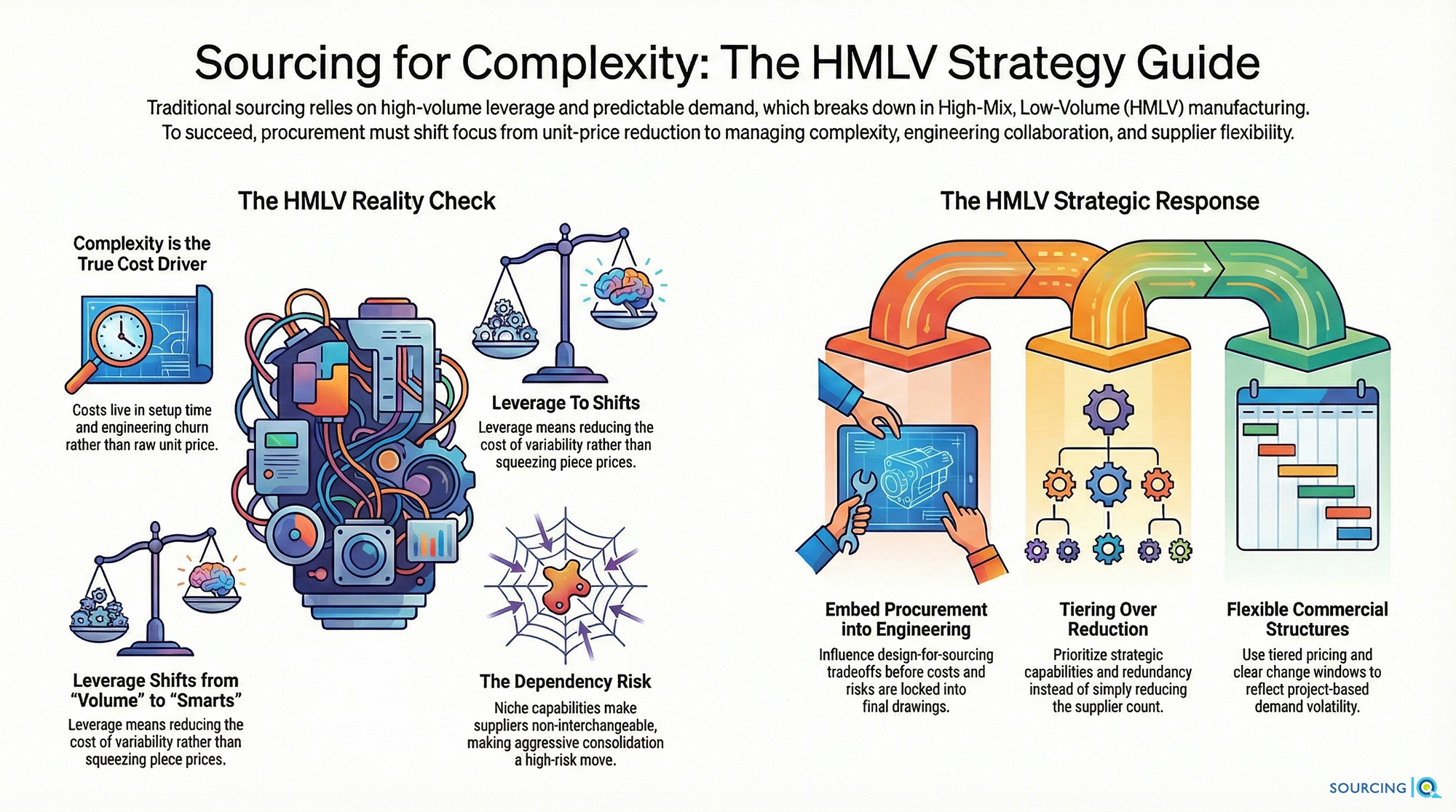
In HMLV, the biggest sourcing costs often live in complexity—setup time, changeovers, engineering churn, and late-stage decision constraints—not just unit price.
If Your Volumes Are Small, Leverage Looks Different
Condition: Your annual volume per SKU is low (dozens, hundreds, maybe a few thousand—not millions).
Implication: Traditional volume consolidation won’t create meaningful price leverage in many categories. Your leverage shifts from “buy more” to “buy smarter.”
What tends to matter more in HMLV than raw unit price:
- Setup and changeover economics (suppliers price complexity)
- Lead time reliability (small lots + volatility punish sloppy planning)
- Flexibility and responsiveness (engineering changes are normal, not rare)
- Commercial structures that reflect variability (terms and tiers matter)
What usually works instead:
- Negotiate around complexity drivers (setup charges, lot size economics, run strategy)
- Align on realistic lead times and variability rules (what changes when demand shifts)
- Prioritize suppliers who can handle short runs efficiently, not just quote low
In HMLV, “leverage” often means reducing the total cost of variability—not squeezing a few points off piece price.
If Engineering Drives Purchasing, Procurement Must Engage Earlier
Condition: You’re engineer-to-order, configure-to-order, or heavily custom. Specs are fluid. Supplier choice is often downstream of engineering decisions.
Implication: If procurement enters at RFQ time, it’s late. Cost and risk are already locked into the design.
What works in HMLV: embed procurement earlier.
Not as a bureaucratic gate—more like an input to prevent avoidable traps.
Early procurement involvement helps:
- Standardize components where it makes sense (without killing customization)
- Identify alternate suppliers before production pressure hits
- Surface cost drivers before they become “non-negotiable”
- Define sourcing constraints (capability, capacity, lead time) while design is still flexible
What tends to fail:
- Sourcing after drawings are final and timelines are tight
- Treating supplier selection like a clerical step
- Discovering qualification barriers when you’re already behind schedule
If engineering is driving purchasing, procurement maturity is measured by how early it can influence design-for-sourcing tradeoffs—without slowing the business down.
If Your Supplier Base Is Niche, Over-Consolidation Creates Risk
Condition: You rely on specialized suppliers (precision machining, complex fabrication, niche processes, hard-to-qualify components).
Implication: Supplier pools are small, capabilities aren’t interchangeable, and qualification cycles are long. In this world, aggressive consolidation can create dependency faster than it creates leverage.
What tends to work: supplier tiering over supplier reduction.
Instead of asking “How do we reduce supplier count?” ask:
- Which suppliers are truly strategic to our operating model?
- Where is redundancy realistic—and where is it not?
- Where does a second source reduce risk vs create distraction?
- What is the recovery plan if a strategic supplier misses?
HMLV reality: dual-sourcing isn’t always feasible. But dependence can still be managed deliberately through:
- Capacity commitments and escalation paths
- Performance expectations and cadence (even for “relationship suppliers”)
- Selective qualification where it matters most
In niche categories, the risk isn’t having “too many suppliers.” It’s having too few without a strategy.
If Demand Is Volatile, Contracts Must Be Flexible
Condition: Demand is project-based, lumpy, or customer-driven. Forecasts are uncertain by nature.
Implication: High-volume contract structures can break HMLV operations. Fixed annual volume agreements and rigid delivery assumptions often create conflict, premiums, and mismatched expectations.
What tends to work: flexible commercial structures that admit reality.
Examples:
- Tiered pricing logic (volume bands instead of one price fiction)
- Flexible delivery schedules with clear change windows
- Transparent assumptions about forecast uncertainty
- Defined change-order processes (so engineering churn doesn’t become silent price creep)
In HMLV, flexibility isn’t a concession. It’s part of the discipline. The goal is to avoid “surprises” that are predictable if you stop pretending demand is stable.
If Your Mix Is Complex, Category Management Still Applies—Differently
Condition: You have high SKU counts, lots of custom work, and wide variation in complexity.
Implication: Category strategy still matters, but sub-categories can’t be defined only by “material type.” In HMLV, it often makes more sense to segment by operating reality:
- Complexity level (setup intensity, tolerance sensitivity, engineering change frequency)
- Engineering intensity (how often specs change, how constrained supplier choice is)
- Capability requirements (special processes, certifications, validation gates)
- Variability profile (stable vs volatile demand)
What tends to work: selective sourcing approaches by segment.
- Standard items (fasteners, packaging, common materials) can use more traditional sourcing plays.
- High-complexity custom assemblies often require relationship-driven sourcing with embedded collaboration.
- RFQs are used strategically—where comparability is feasible and competition improves outcomes.
Blanket RFQ mandates can turn into noise in HMLV. Selective competition tends to produce better results.
What a Practical HMLV Sourcing Strategy Looks Like
Not a giant framework. Just the characteristics that show up consistently in high-performing HMLV procurement teams:
1) Supplier tiering that reflects reality
Strategic suppliers aren’t treated like transactional vendors. Expectations, cadence, and relationship investment are different.
2) Embedded engineering collaboration
Procurement influences design and sourcing constraints early—before cost and risk harden.
3) Selective competitive events
RFQs aren’t automatic. They’re targeted where competition is real and comparability is achievable.
4) Flexible commercial structures
Agreements reflect volatility: tier logic, change windows, and clear assumptions.
5) Performance governance suited to variability
HMLV doesn’t excuse performance ambiguity. Metrics and cadence are still necessary—just tuned to the environment.
HMLV Is Different—But Not Exempt From Discipline
A common misconception in HMLV manufacturing is that variability makes formal sourcing impossible.
In reality, variability increases the need for structure—because without it:
- Supplier dependence grows quietly
- Complexity costs stay invisible
- Engineering changes become unexamined pricing shifts
- Risk accumulates inside niche supplier relationships
HMLV manufacturers don’t win by having the lowest piece price. They win by having sourcing strategies designed for their operating model—deliberate, repeatable, and realistic.
Turn HMLV into a repeatable system – Read Strategic Sourcing for Manufacturers Playbook
Want outside help shaping the model? Learn more about SourcingIQ’s Strategic Sourcing Service