
Most manufacturing organizations don’t have a data problem. They have a structure problem.
Purchasing transactions exist often in abundance, spread across multiple ERP systems, plants, and operational teams. The data is there. What’s missing is the analytical structure that makes it usable.
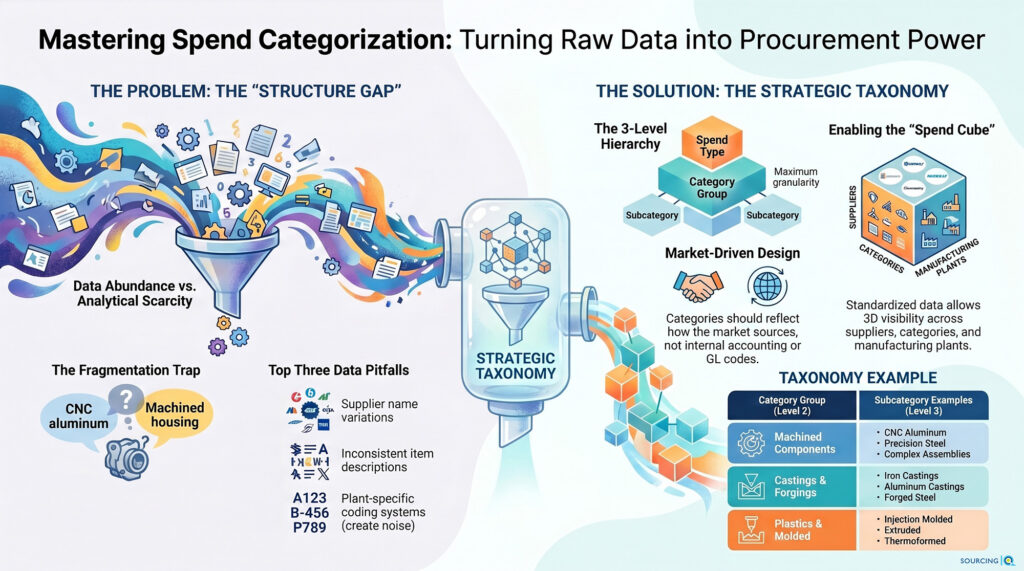
Item descriptions vary by whoever entered the purchase order. Supplier names are inconsistent across systems. Categories were defined locally, by plant, by whoever set up the ERP years ago. And when you try to answer a straightforward question — how much are we spending on machined components across all plants? — you end up reconciling three different systems, a dozen naming conventions, and a category structure that reflects accounting logic rather than procurement reality.
This is the spend categorization problem. And it’s why two manufacturers can have identical purchasing profiles and dramatically different analytical capability.
What Spend Categorization Actually Means
Spend categorization is the process of assigning procurement transactions to standardized categories so spend data can be analyzed consistently across the organization.
Here’s the simplest way to think about it: raw purchasing data describes individual transactions. Spend categorization reveals patterns across them.
Consider three purchase records:
- “CNC machined housing — aluminum”
- “Precision machined enclosure component”
- “Machined aluminum housing — tight tolerance”
In a raw ERP report, these look like three separate line items. Once categorized under a common classification — Machined Components, Aluminum — they become part of the same analytical group. Their combined spend is visible. Their shared supplier relationships can be analyzed. Their consolidation potential becomes apparent.
Without that classification step, the three records stay fragmented. The pattern never surfaces.

Better categorization leads to better decisions. Let’s discuss how to improve spend visibility across your organization.
The Role of Procurement Taxonomies
A procurement taxonomy is the structured classification system that makes consistent categorization possible. Think of it as the organizational architecture for your spend data — the framework that determines how purchasing transactions get assigned to categories, and how those categories relate to each other.
Taxonomies are typically hierarchical, operating at multiple levels of detail:
- Level 1 — Spend type: Direct materials vs. indirect spend
- Level 2 — Category group: Major component families or material types
- Level 3 — Subcategory: Specific part families, material grades, or process types
That hierarchy matters because different procurement decisions require different levels of analytical granularity. A category manager running a sourcing event needs subcategory detail. A CPO reviewing the annual savings pipeline needs category-level visibility. A CFO evaluating procurement ROI needs the top-level view. A well-designed taxonomy supports all three without requiring a different dataset for each.
Without a taxonomy, spend analysis tends to collapse at the seams — each analyst categorizes differently, comparisons across plants or time periods break down, and the “same” report means different things depending on who generated it.
A Direct Materials Taxonomy for Manufacturers
Direct materials spend taxonomies work best when they’re built around how manufacturing actually happens in the market — not how your company manufactures internally or how the general ledger was set up.
A practical high-level taxonomy for direct materials typically looks something like this:
Direct Materials
- Machined Components
- CNC aluminum components
- Precision steel components
- Complex machined assemblies
- Castings & Forgings
- Iron castings
- Aluminum castings
- Forged steel components
- Fabricated Metal Assemblies
- Welded assemblies
- Structural fabrications
- Sheet metal components
- Plastics & Molded Components
- Injection molded parts
- Extruded components
- Thermoformed parts
- Electronics & Electrical Assemblies
- PCBAs
- Wiring harnesses
- Sensors and controls
- Fasteners & Hardware
- Standard fasteners
- Specialty hardware
The right taxonomy for any specific manufacturer depends on product mix, supply chain complexity, and how categories map to actual sourcing decisions. A precision machining company will need more subcategory depth in Machined Components than a company that buys mostly castings. A high-mix electronics manufacturer will need a more detailed Electronics taxonomy than most.
The design principle to keep in mind: categories should reflect how procurement teams make decisions, not how finance tracks cost codes. If your buyers think in terms of “stampings” and “machined parts” and “resins,” your taxonomy should reflect that — not translate everything into general ledger account numbers first.
Common Categorization Challenges
Knowing what the taxonomy should look like is the easier part. Building clean, consistent data against it is where most teams run into trouble. Here are some of the most common pitfalls.
Supplier name variation is the most common issue. The same supplier appears across systems as “ABC Manufacturing,” “ABC Mfg.,” “ABC Mfg Inc.,” and sometimes just “ABC.” Until those records are normalized to a single standard name, supplier-level spend analysis will systematically understate concentration — and consolidation opportunities will be invisible.
Inconsistent item descriptions make automated classification unreliable. ERP line items often reflect whatever the buyer typed at the time of purchase order creation, not a standardized description. “Bracket, steel” and “steel mounting bracket” and “BRK-1024-SS” might all be the same category — but they won’t sort that way without human review or a sophisticated classification algorithm.
Plant-specific coding systems create cross-plant comparison problems. Plant A calls it “precision components.” Plant B calls it “machined parts.” Plant C uses a numeric code that doesn’t translate to either. When you try to aggregate spend across plants, you’re reconciling three different classification schemes simultaneously.
Hybrid components that legitimately span categories are genuinely difficult. A machined casting is both a casting and a machined component. A welded and machined assembly sits in multiple families. There’s no perfect answer — but the classification decision should be made explicitly and applied consistently, not left to individual buyers to interpret.
Because of these challenges, spend categorization almost always requires a combination of automated tools (for high-volume, consistent records) and manual validation (for ambiguous or complex transactions). The automation handles the volume. The human judgment handles the edge cases that automation gets wrong.
How Categorization Connects to Procurement Strategy
Spend categorization isn’t the goal — it’s the enabler. Once purchasing data is structured into a consistent taxonomy, the analytical capabilities that drive procurement strategy become available.
Specifically, structured categorization supports:
Spend cube analysis. The three-dimensional view of spend across suppliers, categories, and plants only works if categories are consistent. Without standardized classification, the category dimension of the spend cube is noise.
Supplier consolidation analysis. To identify categories with fragmented supplier bases, you first need to know which suppliers belong to which categories — consistently, across all plants.
Category strategy development. Sourcing priorities should be set based on category-level spend and risk. That analysis is only as reliable as the category structure underlying it.
Savings opportunity identification. Cross-plant price variation, long-tail supplier spend, and categories without recent sourcing activity are all patterns that emerge from category-level data. Without clean categories, these signals stay buried.
The relationship is direct: better category structure produces better spend visibility, which produces better sourcing decisions.
Data Structure Drives Procurement Insight
Procurement analytics doesn’t fail because manufacturers lack data. It fails because the data isn’t structured in a way that supports analysis.
Spend categorization provides that structure — converting fragmented purchasing transactions into a consistent analytical framework that reflects how materials are actually sourced. When that structure is in place, patterns become visible, opportunities become identifiable, and sourcing strategy can be built on something more reliable than intuition and urgency.
For manufacturers building procurement capability, spend categorization isn’t a reporting task to hand off to the data team. It’s a strategic foundation that determines the quality of every procurement insight that follows.