
Strategic sourcing is one of those phrases that gets tossed around like everyone agrees on what it means. Then you walk into a manufacturing environment and realize: half the strategic decisions are just yesterday’s emergencies wearing a nicer title.
In manufacturing, sourcing isn’t an abstract business exercise. It directly affects production uptime, COGS, supplier reliability, and operational risk. Your strategy has to live in the real world, not in a generic procurement framework.
Sourcing IQ has put together a practical approach you can actually run with a lean team: repeatable steps, clear decision points, and enough structure to create leverage without turning your process into a bureaucracy museum.
What Strategic Sourcing Means in Manufacturing
Strategic sourcing in manufacturing is the disciplined process of managing categories (not random parts) to hit specific cost, risk, and performance objectives.
That means it goes beyond negotiating price on a part-by-part basis. A manufacturing-grade approach requires you to:
- understand total spend across categories and suppliers
- define objectives aligned to production needs
- apply consistent sourcing processes across plants and buyers
- measure and reinforce results over time
Why ad hoc buying undermines leverage (and usually performance)
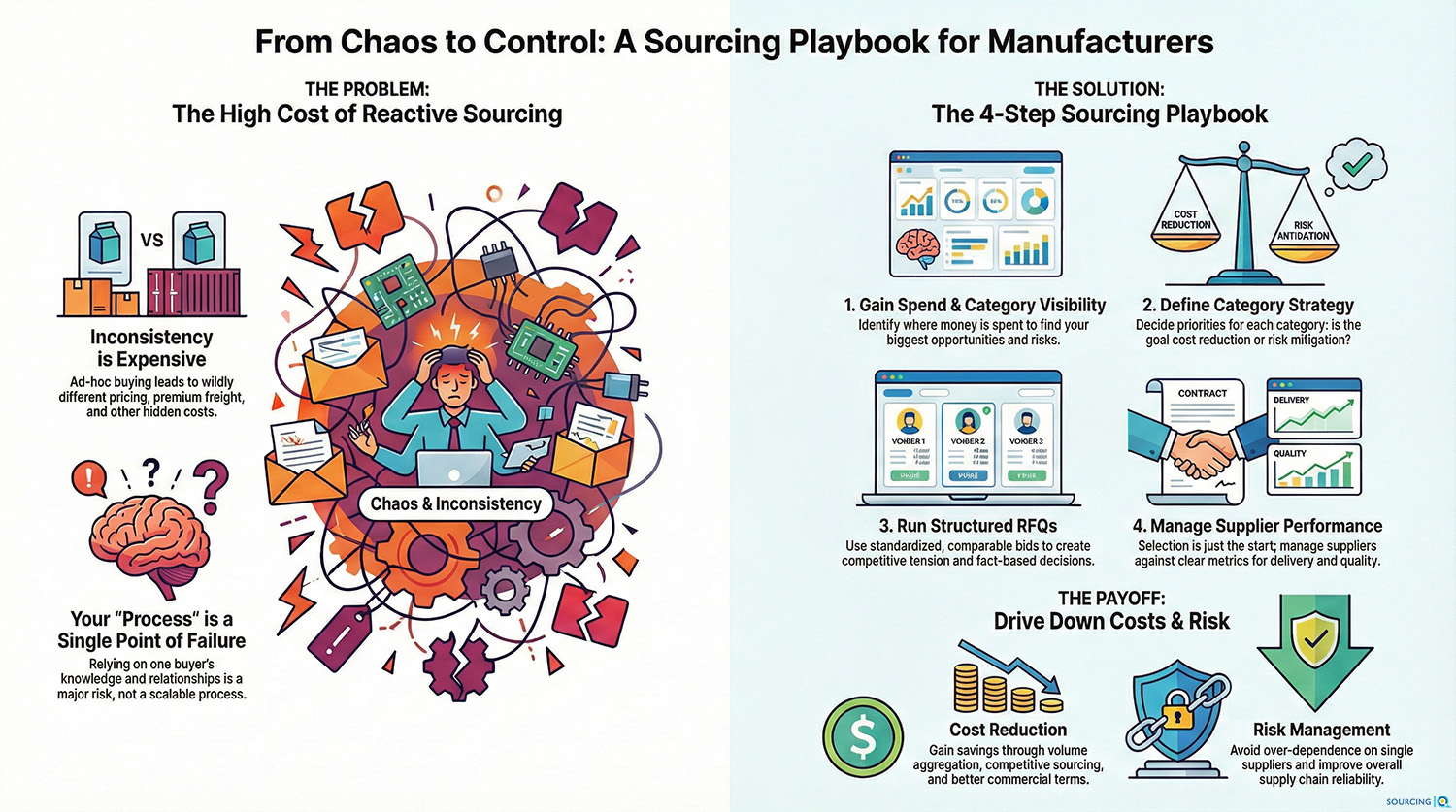
When sourcing is reactive, a few predictable things happen:
- suppliers price to uncertainty (“just in case”)
- plants create local workarounds
- similar parts get wildly different pricing
- you “save” money in one place and spend it back in premium freight or increased costs somewhere else
Strategic sourcing replaces one-off negotiations with a managed discipline because in manufacturing, inconsistency is expensive.
Why Manufacturers Need a Sourcing Playbook
A lot of manufacturers rely on insider knowledge: experienced buyers who “know the suppliers” and can make things happen through relationships and hustle. That can work for a while—until the organization grows, the team changes, a supplier misses, or the market shifts.
A sourcing playbook gives you:
- Consistency across plants, categories, and buyers
- Repeatability so outcomes don’t depend on heroics
- Transparency in how decisions are made
- Scalability as you grow or acquire new operations
If your best sourcing process lives in one person’s head, you don’t have a process—you have a single point of failure.
The Core Elements of a Manufacturing Strategic Sourcing Playbook
This is the heart of it. You don’t need complex tools or a giant org chart. You need a few core disciplines executed consistently.
Spend and Category Visibility
The foundation of any sourcing playbook is visibility into where money is actually being spent.
The goal is not “perfect data.” The goal is actionable clarity:
- total spend by category and supplier
- fragmentation across suppliers (where you’re leaking leverage)
- concentration risk (where you’re overexposed)
- categories that have real impact vs. noise
Practical tip: build categories the way manufacturing actually works externally for your suppliers (not internally)—machined components, stamped parts, castings, resins, packaging, electronics. Then prioritize: pick the top 3–5 categories where the impact is meaningful and execution is feasible.
Category Strategy Definition
Each category should have a defined sourcing strategy that reflects its importance and constraints.
A category strategy should address:
- cost reduction vs. risk mitigation priorities
- supplier market dynamics
- quality and performance requirements
- capacity and lead-time considerations
And this is where manufacturing gets real: different categories demand different plays.
A commodity raw material might be well-suited for competitive sourcing and consolidation. A specialized component with qualification barriers might require a more relationship-driven approach, dual sourcing, or supplier development.
Rule of thumb: if a supplier miss stops the line, “lowest price” is not a strategy. It’s a dare.
Structured RFQs and Competitive Events
RFQs are where sourcing strategy gets executed. An effective playbook should define:
- when RFQs are required
- how RFQs are structured for comparability
- how suppliers are selected and evaluated
- how negotiations are conducted and documented
Structured RFQs create competitive tension, transparency, and fact-based decision-making. Informal RFQs weaken leverage and make results hard to replicate.
What “structured” actually means (not just a nice idea):
- clear scope (parts, volumes, plants/programs, terms)
- standardized bid fields (unit price, tooling, MOQ, lead time, surcharges/indexing, payment terms, incoterms)
- a Q&A window to align assumptions
- a clean evaluation model (so you’re not comparing apples to… forklifts)
RFQs are a tool, not a strategy. But without a disciplined RFQ process, your strategy stays theoretical.
Supplier Selection and Performance Management
Selecting a supplier is not the end of sourcing—it’s the start of managing outcomes.
A manufacturing sourcing playbook should define supplier expectations for:
- on-time delivery
- quality and defect rates
- responsiveness and communication
- continuous improvement efforts
Managing suppliers against clear performance metrics reduces operational risk and strengthens long-term relationships.
A simple performance cadence beats an elaborate dashboard nobody uses:
- monthly for critical suppliers/categories
- quarterly for stable suppliers
- clear thresholds and consequences (volume shift, corrective action, exit plan)
How Strategic Sourcing Supports Cost Reduction and Risk Management
Strategic sourcing enables manufacturers to address cost and risk simultaneously.
On the cost side, playbooks support savings through:
- volume aggregation and consolidation
- competitive sourcing and benchmarking
- improved commercial terms
- specification alignment
On the risk side, they help manufacturers:
- avoid over-dependence on single suppliers
- improve supplier reliability and performance
- increase visibility into supply constraints
- make deliberate tradeoffs between cost and continuity
That last bullet is the expert level of procurement: making tradeoffs explicitly, not accidentally.
Common Strategic Sourcing Mistakes in Manufacturing
Even good sourcing initiatives fail for predictable reasons. Here are the big ones.
Treating sourcing as a one-time project
Markets change. Volumes shift. Suppliers evolve. Strategic sourcing has to be ongoing.
Skipping spend analysis
If you don’t know where the money is, you’ll waste time on low-impact categories and miss the big levers.
Overcomplicating the process
Complex playbooks don’t get used. Simplicity enables execution—especially for lean teams.
Failing to document and repeat
If knowledge lives only in individuals’ heads, results disappear when teams change.
(Translation: if your “process” requires one specific person to be having a good week, it’s not a process.)
Turning the Playbook Into a Repeatable Process
A sourcing playbook delivers value only if it gets used consistently.
To make it real, focus on:
Governance and ownership
Define who owns which categories, who approves awards, and how exceptions are handled. “Everyone owns it” is how you end up with “no one owns it.”
Cadence and prioritization
Strategic sourcing is a pipeline process. You don’t do everything at once.
- pick priority categories
- run structured events
- implement awards
- measure performance and savings
- repeat
Building sourcing muscle over time
The goal isn’t perfection—it’s disciplined execution that improves over time.
The most valuable outcome of a playbook is not one set of savings. It’s a team that can produce savings repeatedly without reinventing the wheel every quarter.
Final Thoughts: Strategic Sourcing Works When It’s Practical
Strategic sourcing in manufacturing works when it’s practical, repeatable, and aligned with production realities—not abstract, one-size-fits-all models.
It doesn’t require complex tools or large teams. It requires clarity, structure, and follow-through.
If you want the shortest path to traction: start by getting spend/category visibility, pick two categories with real impact, and run one disciplined sourcing event end-to-end (including implementation). Do that consistently, and “strategic sourcing” stops being a slogan and starts being a system.
Put the playbook into action – Read Direct Materials Cost Reduction – 12 Levers
Need implementation horsepower? Learn about SourcingIQ’s project management