
Supplier consolidation is one of the most common cost-reduction strategies in manufacturing—and one of the easiest to misunderstand.
Yes, consolidation can create leverage, simplify operations, and reduce cost. Under the wrong conditions, it does the opposite: it increases dependency, reduces resilience, and turns one supplier problem into a production problem.
The difference between a smart consolidation and a risky one is rarely “execution effort.” It’s whether consolidation is being applied under the right conditions for that category.
There’s one conditional caveat to everything below: if these conditions exist, consolidation tends to work; if not, it tends to create risk. This is our small guide to help your business decide where consolidation is a fit—and where it’s a trap.
When Supplier Consolidation Tends to Work
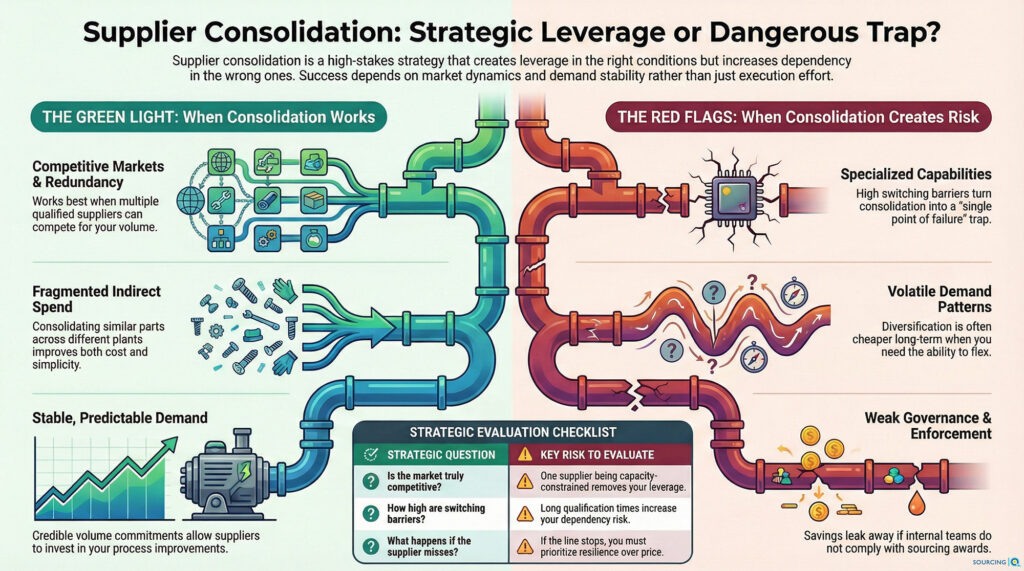
Consolidation tends to help when market dynamics, internal demand patterns, and operational constraints line up in your favor. In these scenarios, consolidation can improve outcomes without quietly increasing risk.
Here’s how this plays out in some common scenarios.
Scenario 1: Competitive supplier markets with redundant capacity
If multiple qualified suppliers can meet your requirements and there’s meaningful competition, then consolidation can create leverage without turning into a single-point-of-failure.
In this scenario, consolidation works because:
- suppliers are motivated to compete for volume
- capability redundancy reduces dependency risk
- switching costs are manageable (qualification, tooling, validation)
- you can credibly shift volume if performance slips
The risk profile here is usually controllable. If a supplier underperforms, you still have options—so consolidation becomes a strategic lever rather than a gamble.
Where this often goes next: a structured RFQ to create clean comparability and reset market pricing.
Scenario 2: High spend concentration across similar items (but fragmented suppliers)
If spend is fragmented across many suppliers for materially similar parts/materials, then consolidation often improves both cost and operational simplicity.
This is the “your organization evolved organically” scenario. It shows up when:
- plants buy similar components locally
- specs vary slightly but don’t need to
- supplier lists grew via one-off decisions
- pricing varies for functionally similar items
Consolidation works here because aggregation creates leverage and standardization removes friction:
- fewer suppliers to manage
- fewer pricing structures and terms to reconcile
- less administrative work for buyers
- cleaner visibility into performance issues
This scenario is usually discovered through spend analysis—because it’s hard to see fragmentation until you look at spend across plants and programs.
Where this often goes next: Direct Materials Spend Analysis → consolidation opportunity → Direct Materials Cost Reduction (and then RFQs if the market supports competition).
Scenario 3: Mature categories with stable, predictable demand
If demand is stable and forecasts are credible, then consolidation tends to be safer and more effective.
Stable demand matters because it allows:
- credible volume commitments (which create pricing leverage)
- better supplier capacity planning
- fewer “surprise expedites” that strain the relationship
- suppliers to invest in process improvements, fixtures, or automation
In mature, stable categories, consolidation often becomes mutually beneficial: you simplify your supply base, and the supplier can plan and support you with less volatility.
Where this often goes next: commercial term improvements (freight models, inventory agreements, tooling ownership) and performance expectations that stick over time.
When Supplier Consolidation Creates Risk
Consolidation usually fails when it’s pursued primarily for cost—without accounting for supplier market realities, qualification barriers, or execution governance.
These scenarios don’t mean “never consolidate.” They point out that consolidation can increase risk unless you deliberately mitigate it.
Scenario 4: Limited supplier markets or specialized capabilities
If there are only a few capable suppliers—or the process is specialized and hard to qualify—then consolidation increases dependency fast.
In this scenario, consolidation can backfire because:
- switching barriers are high (tooling, validation, customer approvals)
- suppliers know you have limited options
- recovery options are slow when disruptions happen
- supplier leverage tends to grow over time, not shrink
This is where manufacturers confuse “consolidation” with “getting trapped.”
A safer move in many specialized categories is intentional dependency management:
- build a development plan with the supplier
- secure capacity commitments
- define performance metrics and escalation paths
- qualify a second source where feasible (even if it’s partial)
Where this often goes next: “alternative supplier qualification” and performance management—more than an aggressive consolidation push.
Scenario 5: Volatile demand or capacity-constrained categories
If demand swings hard or the category is capacity-constrained, then consolidation reduces your ability to flex and increases your exposure to premiums and disruption.
In this scenario, consolidation can create problems because:
- suppliers can’t flex capacity quickly
- single points of failure become more consequential
- volatility drives premium pricing and expedite behavior
- you lose optionality right when you need it most
This is one of the most common consolidation mistakes: the business consolidates to “simplify,” and then demand spikes, a supplier can’t respond, and procurement spends the next quarter buying their way out of the decision.
When volatility is real, diversification is often the cheaper path long-term—because it protects uptime and reduces the hidden costs of disruption.
Where this often goes next: demand normalization and forecast alignment (yes, boring… also yes, powerful), which is one of the cost reduction levers most teams underuse.
Scenario 6: Weak supplier performance management and weak governance
If you don’t have a reliable way to manage supplier performance or enforce sourcing decisions, then consolidation can erode savings and performance over time—even when the supplier market is favorable.
Consolidation fails here because:
- savings leaks through exceptions and noncompliance
- performance issues aren’t addressed systematically
- the consolidated supplier gains leverage without accountability
- internal teams revert to “whatever works today” buying behavior
This scenario is why “fewer suppliers” is not a strategy by itself. Consolidation increases the importance of governance because you’ve reduced your safety net.
Where this often goes next: governance, compliance routines, and repeatable sourcing discipline.
Questions Manufacturers Should Ask Before Consolidating
The decision isn’t “Will consolidation save money?” It’s: “Under our conditions, will consolidation improve outcomes without creating unacceptable risk?”
Use these condition-based questions to evaluate a category:
- Is the supplier market truly competitive?
If you have two capable suppliers and one is capacity-constrained, you don’t have competition—you have a negotiation story. - Are requirements standardized enough to consolidate responsibly?
If every plant has different specs, packaging, or lead-time needs, consolidation becomes a forced fit (and forced fits break). - How high are switching and qualification barriers?
If qualification is long and expensive, dependency risk increases. Plan accordingly. - How stable is demand over the planning horizon?
Consolidation is easier when volume commitments are credible. - What happens if the supplier misses?
If the line stops, your consolidation decision must include resilience planning—not just pricing. - Do we have governance to enforce awards and manage exceptions?
If compliance is optional, savings will be temporary. - Do we have a plan to manage performance after consolidation?
Consolidation increases the importance of cadence: reviews, metrics, escalation, corrective action.
These questions keep consolidation from becoming a default tactic and force it to be a deliberate strategy choice.
Consolidation Works When Conditions Are Right
Supplier consolidation isn’t inherently good or bad. It’s a tool that can create leverage—or create dependency—depending on conditions.
Manufacturers that evaluate consolidation through a conditional lens make better sourcing decisions because they balance:
- cost opportunity
- operational risk
- market dynamics
- qualification constraints
- governance capability
When consolidation fits, it can simplify operations and improve economics. When it doesn’t, diversification (or deliberate dual-sourcing) is often the smarter move—even if it looks “less efficient” on paper.