
Private equity firms don’t invest in manufacturing businesses expecting instant procurement savings. They invest because they believe the combined business can become worth more than the sum of the individual companies operating separately, and procurement is often one of the clearest ways to prove that thesis out.
After a series of acquisitions, portfolio companies frequently buy many of the same materials, use similar suppliers, negotiate separately, and independently solve the same sourcing problems without ever realizing it. On paper, the synergy looks obvious. In practice, capturing it is a lot harder.
Each acquired business carries its own suppliers, engineering standards, purchasing processes, ERP systems, and operating culture. Simply telling every plant to “buy together” tends to create as many problems as it solves. The firms that get this right understand that procurement integration isn’t about centralizing purchasing. It’s about building shared capability across the portfolio while preserving the operational flexibility each business actually needs.
A Familiar Roll-Up Scenario
Picture a PE firm that’s acquired three manufacturing companies over four years: a precision machining business serving industrial OEMs, a metal fabrication company supporting heavy equipment manufacturers, and an assembly operation producing finished industrial products.
Each company built a capable procurement function. Each negotiates independently. Each believes its sourcing approach is unique to its business. When the operating partner finally looks at portfolio-wide spend, the overlap is substantial: carbon and stainless steel, aluminum, fasteners, corrugated packaging, industrial gases, MRO supplies, freight services, safety equipment. Collectively, tens of millions of dollars in annual spend. Individually, each company negotiates as if it’s alone in the market.
The opportunity isn’t about bigger contracts. It’s a smarter procurement organization across the whole portfolio.
Step One: Build Visibility Before Touching Anything
The most common post-acquisition mistake is assuming synergies can be identified immediately. Experienced operating partners resist that instinct.
Before changing a single supplier or renegotiating a single contract, they understand the portfolio first. What does each business actually buy? Which suppliers are shared, even under different names? Where are current contracts already competitive? Which categories have the most overlap? Which suppliers consistently outperform? Where do engineering specs block competition entirely?
Getting real answers requires actual spend analysis, not assumptions. Portfolios routinely discover the same supplier listed under three different names across three plants or duplicate suppliers serving facilities a few miles apart from each other. Without that visibility, integration is guesswork wearing a strategy’s clothes.
Step Two: Evaluate by Category, Not Blanket Policy
Once spend is visible, the smart move is category-by-category evaluation, because not every category benefits equally from consolidation.
Commodity categories tend to be excellent candidates: steel, packaging, industrial gases, safety products, freight, office supplies, maintenance materials. Greater volume improves commercial leverage and cuts administrative complexity without much operational risk.
Other categories need real caution: customer-approved components, proprietary assemblies, specialized tooling, highly engineered castings, precision-machined parts, custom electronics. These often depend on customer requirements, manufacturing capability, quality certifications, or engineering expertise that can’t just be standardized across businesses without real disruption.
The objective is thoughtful alignment, not universal consolidation. Every category deserves its own answer.
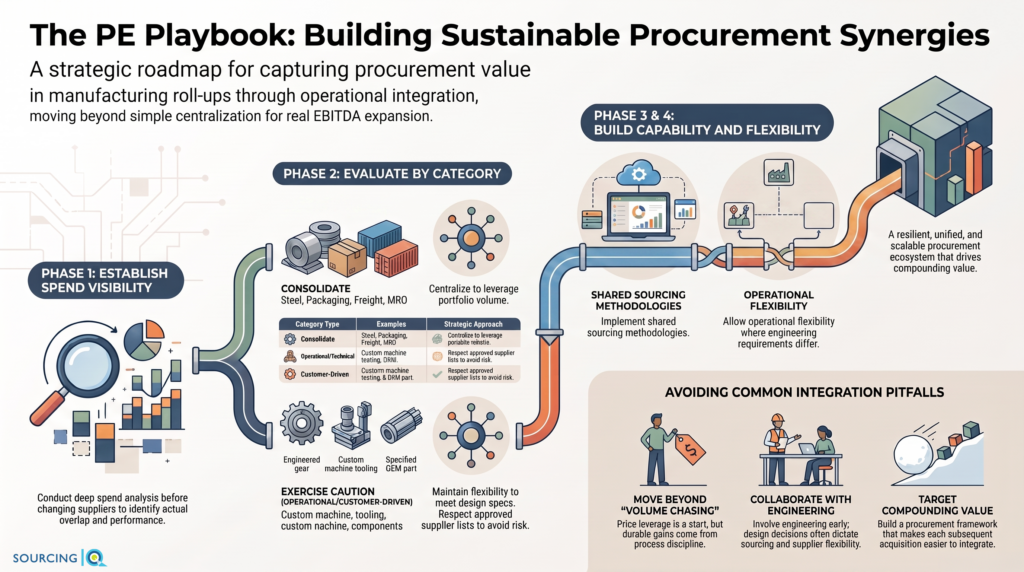
Step Three: Build Shared Capabilities, Not Just Bigger Contracts
The biggest procurement synergies rarely come from one large, negotiated contract. They come from improving how procurement operates across the whole portfolio.
High-performing PE firms introduce shared category strategies, standard sourcing methodology, common supplier scorecards, shared analytics, cross-company sourcing councils, supplier performance reviews, and best-practice sharing between procurement teams. Done well, this strengthens local expertise. Plant buyers keep supporting day-to-day operations while gaining access to broader market intelligence, better negotiation resources, and lessons already learned elsewhere in the portfolio.
Over time, procurement gets meaningfully more consistent without becoming unnecessarily centralized.
Step Four: Preserve Local Flexibility Where It Actually Matters
One of the fastest ways to undermine integration is forcing every plant onto identical suppliers regardless of fit. Manufacturing operations aren’t identical. Plants make different products. Customer specifications require different supplier capabilities. Regional logistics shape transportation cost differently by site. Equipment requires different technical capabilities.
Trying to erase every difference usually creates operational friction that outweighs whatever sourcing savings you were chasing. The distinction that actually matters here is standardization versus strategic alignment. Standardization means everyone operates identically. Strategic alignment means the portfolio shares common procurement principles while preserving operational flexibility where it’s genuinely justified. Getting that distinction right is often what separates integration that works from integration that stalls.
What Sustainable Synergies Actually Look Like
Done well, this produces lower total cost, better supplier leverage, improved spend visibility, stronger supplier performance, less sourcing duplication, tighter governance, and real EBITDA expansion. Crucially, these results compound. Each subsequent acquisition benefits from existing supplier intelligence, proven methodology, category expertise, and established governance instead of starting from zero. The procurement function gets stronger with every deal rather than more complicated.
Common Mistakes That Limit the Value
Chasing volume alone. Combining purchasing volume helps pricing. It rarely captures the full available value on its own. The durable gains come from capability, supplier performance, and process discipline.
Moving too fast. Consolidating suppliers immediately after close looks decisive. It can also introduce quality issues, production disruption, and strained customer relationships if the operational differences weren’t fully understood first.
Ignoring engineering and operations. Procurement can’t make every sourcing decision alone. Requirements, manufacturing processes, quality standards, and customer expectations all shape supplier selection. Cross-functional input consistently beats decisions made in isolation.
Measuring success only by the first round of savings. Early sourcing events get the attention. The larger value tends to show up over several years through better governance, stronger supplier management, and increasingly sophisticated category strategy. And these improvements keep generating value long after the initial negotiations wrap up.
Procurement Synergies Are Built, Not Discovered
Procurement synergies don’t just materialize because multiple businesses share an owner. They get built deliberately, through disciplined integration, category-specific strategy, shared capability, and real cross-functional collaboration.
The strongest PE firms understand that procurement shouldn’t just cut purchasing cost. It should strengthen the portfolio’s entire operating model. By building procurement organizations that get smarter and more consistent with every acquisition, operating partners create value well beyond a single round of sourcing events.
The best manufacturing roll-ups don’t win because they buy more. They win because they build procurement capability that scales alongside the portfolio. Firms can create stronger supplier relationships, more disciplined sourcing, and EBITDA improvement that compounds with every new company added.