
The RFQ gets run. Suppliers get selected. Pricing gets negotiated. Implementation happens. And then, almost without anyone deciding it should happen, supplier management quietly stops being structured.
Delivery starts slipping a little. Quality gets inconsistent. Communication turns reactive. You speak with the supplier when something’s wrong, but otherwise, not at all. None of it happens overnight. It slowly erodes. And by the time anyone notices, a meaningful chunk of the value that RFQ created has quietly walked out the door.
Here’s the distinction that matters: sourcing and supplier management are not the same discipline. Sourcing creates the opportunity. What happens after determines whether that opportunity turns into sustained value or a slow leak. The procurement organizations that protect their sourcing gains build supplier performance management around four things: visibility, measurement, accountability, and continuous improvement.
Stage 1: Get Visibility Before You Try to Improve Anything
You can’t manage what you can’t see, and most procurement teams are flying on anecdotes and vibes. A supplier looks “good” because they respond to emails fast. Another looks “bad” because of one recent delivery miss everyone remembers. Relationships and gut feel matter, but they’re not a performance management system.
Real visibility means tracking on-time delivery, quality performance, responsiveness, pricing adherence, and supply continuity consistently, not just when something breaks. Without that baseline, you only find out about problems after they’ve already cost you a production day.
Stage 2: Measure What Actually Moves the Needle
Once visibility exists, resist the urge to measure everything. A 20-metric scorecard dilutes attention from the handful of indicators that actually predict trouble.
Delivery performance (on-time percentage, lead-time adherence) matters because it has immediate, physical consequences on your production floor. Quality (defect rates, returns, corrective actions) matters because quality problems cost far more than the part price. Commercial performance (pricing consistency, contract compliance, willingness to engage on cost reduction initiatives) tells you whether the relationship is actually working in your favor. And responsiveness tells you what happens after something goes wrong, which is usually more revealing than whether anything goes wrong at all.
Pick the handful that matter for your categories. Ignore the rest.
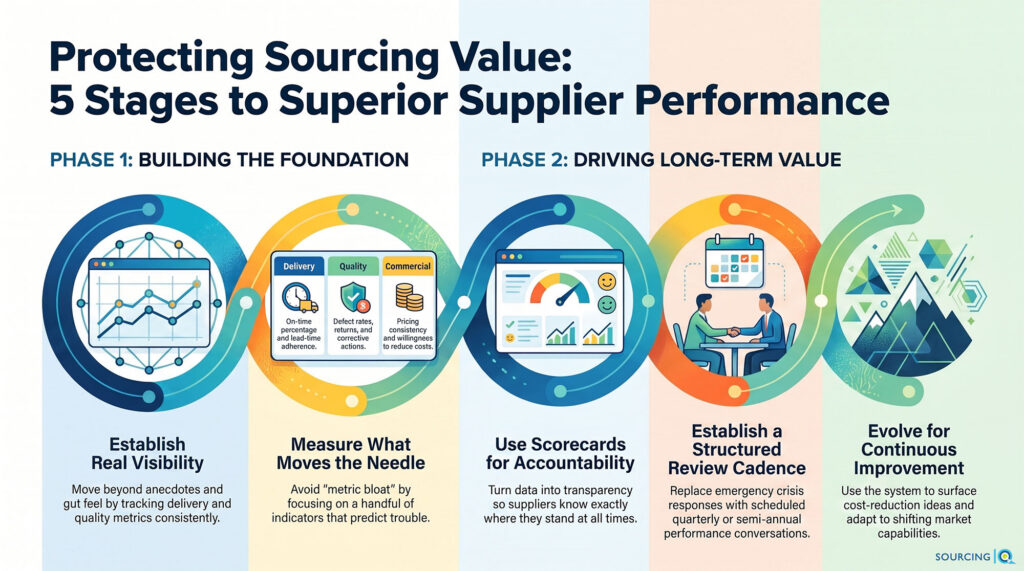
Stage 3: Turn Data Into Accountability With Scorecards
Measurement without accountability is just a report nobody reads. Scorecards are what turn data into a conversation suppliers can actually act on.
A good scorecard is a transparency mechanism. It tells a supplier exactly where they stand, consistently, over time. Suppliers tend to perform better the moment expectations are visible and unambiguous, because most underperformance isn’t malicious. It’s just unmanaged.
Stage 4: Make Reviews a Cadence, Not an Emergency Response
If the only time you talk to a supplier about performance is during a crisis, you’ve built a reactive relationship by accident. Structured reviews — quarterly, semi-annually, or whatever fits the category — change the dynamic entirely.
These conversations should cover delivery trends, quality data, open issues, and what’s coming next from both sides. Suppliers managed on a cadence tend to surface problems earlier, because they know there’s a forum for it instead of waiting to get called out.
Stage 5: Use the System to Drive Improvement, Not Just Track It
A scorecard that never changes anything is a reporting exercise, not a performance management system. Strong suppliers should improve over time by contributing ideas, participating in problem-solving, and flagging cost-reduction opportunities before you ask.
And the obligation runs both directions. Markets shift, demand shifts, and supplier capabilities evolve. Your performance management approach should evolve too, not stay frozen when you first built the scorecard.
Where This Usually Breaks Down
A few patterns show up constantly: measuring too many KPIs and acting on none of them, collecting performance data and never turning it into a conversation, reviewing suppliers on an inconsistent schedule, and only engaging suppliers when something’s already broken. None of these require a bigger system to fix. They require discipline applied to a simpler one.
Performance Management Protects What Sourcing Created
RFQs and negotiations create the opportunity. What happens for the next three years of the contract determines whether that opportunity sticks or quietly evaporates. The manufacturers who get the most out of their supplier base aren’t the ones who run the best RFQ. They’re the ones who keep managing the relationship with the same discipline after the ink dried.