Most procurement organizations don’t reach their current state by design. They get there through accumulation: buyers added as plants grew, processes that emerged in response to specific problems, supplier relationships that developed independently across facilities, and sourcing discipline that improved unevenly depending on who was in which role at any given time.
The result is that procurement maturity varies dramatically across manufacturing organizations and even sometimes across plants within the same company.
Some manufacturers are running structured, analytically driven sourcing programs that produce consistent savings and scale alongside the business. Others are still primarily reacting to the last shortage, the last price increase, or the last supplier failure. And many are somewhere in the middle: capable in some categories, reactive in others, with pockets of real sophistication surrounded by legacy processes nobody has gotten around to changing.
Understanding where your procurement organization sits matters because maturity affects outcomes directly. It determines how consistently savings get captured, how much leverage the supply base experiences, how visible spend patterns are, and whether improvements persist or erode. Procurement maturity is not primarily a function of headcount or technology. It’s a reflection of how systematically sourcing actually operates on an ordinary Tuesday, not just during a cost reduction initiative.
Here’s a model for understanding the progression.
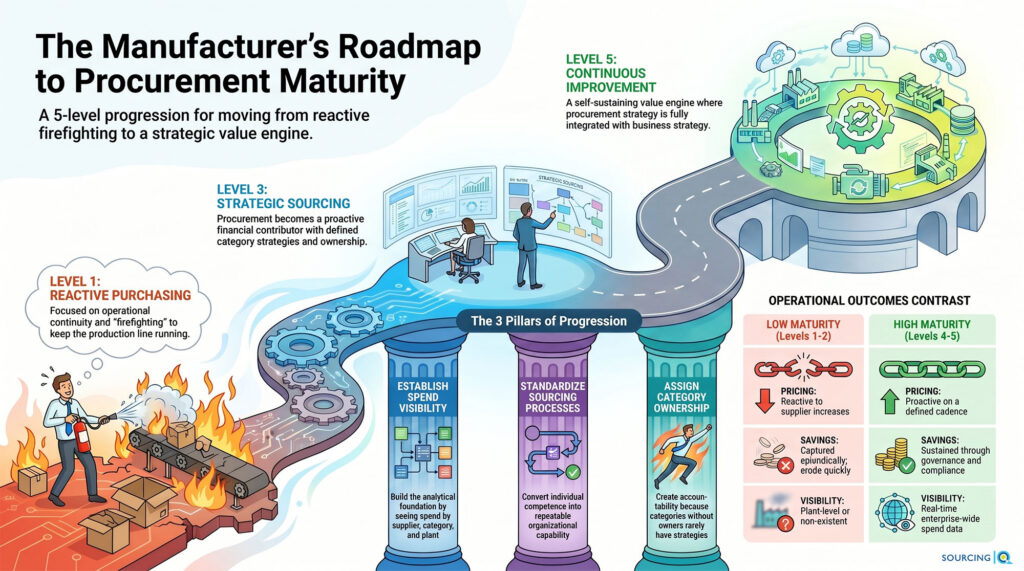
Level 1 — Reactive Purchasing
At the base level, procurement is almost entirely transactional and reactive. The organization buys what production needs, when production needs it, from whoever can deliver. The focus is operational continuity: keeping the line running. And procurement is the function that makes sure parts show up.
What this looks like in practice:
- Purchasing decisions are made plant by plant, often by whoever is closest to the need
- Supplier bases grew organically, not strategically. There are often more suppliers than necessary, with overlapping capabilities and inconsistent pricing
- Spend data exists in ERP systems but nobody has organized it into a coherent picture
- Sourcing “events” are mostly reactive renegotiations triggered by a price increase letter or a supply disruption
- Buyers are skilled at expediting and problem-solving; strategic sourcing skills are largely undeveloped
The feeling of Level 1 is constant firefighting. Everything is urgent. There’s no bandwidth for anything other than keeping production running.
This stage is common in smaller manufacturers, high-growth companies that scaled faster than their procurement infrastructure, and plants within larger organizations that never received structured procurement investment.

Benchmark Your Procurement Function Against Industry Best Practices
Get ongoing insights, frameworks, and practical guidance to help your team advance procurement maturity over time.
Level 2 — Structured Procurement
At Level 2, structure begins to emerge. The organization starts running RFQs more consistently, at least for significant purchases. Spend data gets pulled and reviewed periodically. Supplier comparisons become somewhat more formalized. Early sourcing initiatives start producing measurable savings.
The defining characteristic of Level 2 is intentionality. Procurement is no longer purely reactive, but the improvements are inconsistent. Sourcing discipline exists in pockets. Some buyers run structured processes; others don’t. Some categories get competitively sourced; others haven’t been touched in years.
What this looks like:
- RFQs are used when leadership pushes for cost reduction, but not as a standard operating rhythm
- Some spend analysis has been performed, usually as a one-time exercise rather than an ongoing discipline
- Savings get captured from specific initiatives but tend to erode between them
- Procurement improvements depend heavily on individual effort rather than embedded organizational process
Level 2 is where many mid-market manufacturers live. They’ve seen what structured sourcing can produce. They’ve run initiatives that delivered results. But the capability hasn’t become systematic. It’s episodic and dependent on specific people and circumstances.
Level 3 — Strategic Sourcing
Level 3 is where procurement begins operating proactively rather than reactively. The organization has moved from managing individual transactions to managing categories with defined strategies, ownership, and sourcing cadence.
Characteristics at this level:
- Categories are mapped and prioritized based on spend magnitude and strategic importance
- Sourcing ownership is assigned — someone is accountable for each major spend area
- Supplier evaluation processes are standardized well enough that different buyers produce comparable outcomes
- Savings are tracked formally, tied to specific actions and baseline pricing
- Procurement has begun building analytical capability: spend visibility, cross-plant comparison, category performance tracking
At Level 3, procurement is a strategic contributor to financial performance of a company, not just an operational support function. Supplier relationships are more intentional. Decisions are based on capability, performance, and strategic fit, not just familiarity and availability.
This is also the level where the “keep the money” problem first appears clearly. Organizations at Level 3 can generate real savings. They often struggle to sustain them because governance and compliance discipline haven’t fully developed yet.
Level 4 — Integrated Procurement Organization
At Level 4, procurement becomes coordinated across the enterprise rather than operating as a collection of local activities. Cross-plant sourcing strategies are aligned. Supplier relationships are managed at the enterprise level. Procurement governance exists and functions well. Decisions get made consistently, exceptions are tracked, and compliance to sourcing decisions is visible.
Sophistication isn’t what distinguishes Level 4 from Level 3, it is integration:
- Enterprise spend visibility replaces plant-level or category-level views
- Supplier strategies are aligned across plants: the same supplier is managed with consistent performance expectations everywhere it operates
- Procurement analytics are incorporated into routine sourcing decisions rather than reserved for special projects
- The organization can leverage total purchasing volume, not just plant-level volume
- Procurement capability is less dependent on specific individuals — processes and structures carry the discipline even when people change roles
At this level, procurement can scale. Adding a new plant or integrating an acquisition doesn’t require rebuilding procurement from scratch because the organizational model, process standards, and governance mechanisms extend naturally.
Level 5 — Continuous Improvement Procurement
Level 5 is the stage where procurement operates as a self-sustaining value engine. The organization isn’t running sourcing events on a cadence. It’s continuously evaluating the supply base, refining sourcing strategies, developing supplier capabilities, and improving procurement processes based on what’s been learned.
Characteristics at Level 5:
- Sourcing playbooks are documented, used, and updated. Institutional learning accumulates rather than disappearing when people leave
- Supplier performance management is systematic: metrics, reviews, escalation paths, and consequence are all operating in a defined rhythm
- Spend visibility is current, not historical. The organization knows what it’s spending now, not just what it spent last year
- Procurement capability development is ongoing: buyers are getting better over time through structured development, not just experience
- Procurement strategy is integrated with business strategy. Sourcing decisions reflect growth plans, product roadmaps, and risk tolerance
At this stage, procurement doesn’t just capture value; it compounds it. Each sourcing cycle builds on the last. Each new capability accelerates the next.
Most mid-market manufacturers aren’t at Level 5, and they don’t need to be to significantly outperform their current state. The goal isn’t Level 5 in Year 1. It’s deliberate progression toward the next level.
Common Signals That Procurement Maturity Is Lower Than It Should Be
These patterns appear frequently in organizations operating below their potential:
- Buyers are consumed by transactional work with no protected time for strategic sourcing
- Sourcing ownership is unclear. Categories get managed by whoever has the relationship, not by defined accountability
- Suppliers are added routinely without structured evaluation or any assessment of fit with the existing base
- Similar components carry different prices across plants, and nobody has a clear picture of the variance
- Pricing negotiations happen in response to supplier price increase letters rather than proactively on a defined cadence
- Sourcing activities aren’t documented. Each RFQ starts fresh, institutional learning doesn’t accumulate
- Savings get reported but don’t show up in actual spend data three months later
These aren’t failures of individual effort. Capable people operating inside a system that doesn’t support sourcing discipline will produce inconsistent results because the environment doesn’t enable anything else. These are structural outcomes.
Why Procurement Maturity Has a Financial Signature
The financial difference between Level 1 and Level 3 procurement in a mid-market manufacturing company is significant — not as a theoretical claim, but as an operational reality.
Higher maturity organizations produce more consistent sourcing savings because they have the process discipline to run events repeatedly and the governance to make results stick. They generate better leverage because they can see and coordinate spend across the enterprise. They sustain improvements because governance and compliance prevent the savings from leaking back out.
Lower maturity organizations capture savings episodically and lose them gradually. They buy reactively, which means suppliers price in uncertainty. They miss consolidation opportunities because nobody has a cross-plant view. And they depend on specific individuals. When those individuals leave or move, the sourcing capability often goes with them.
The compounding effect is real: organizations that invest in procurement maturity over a three-to-five-year horizon don’t just capture more savings. They build a capability that gets more effective over time.
How Procurement Maturity Actually Improves
The path from Level 1 to Level 3, which is where most meaningful impact occurs, doesn’t require a transformation program. What it does require is consistent, deliberate improvement in a few foundational areas:
Spend visibility is almost always the starting point. You can’t prioritize what you can’t see. Building a clear picture of where money is going — by supplier, category, and plant — is the analytical foundation for everything else.
Sourcing process standardization converts individual competence into organizational capability. When processes are consistent, outcomes are repeatable. When outcomes are repeatable, teams get better over time.
Category ownership creates the accountability that strategic sourcing requires. Categories without owners don’t have strategies. Categories with owners do.
Capability development ensures the organization gets better at sourcing over time rather than maintaining a fixed level of skill. The training article in this cluster covers this directly.
Organizational alignment between procurement, operations, engineering, and finance prevents the cross-functional disconnects that undermine even well-designed sourcing initiatives.
Progress on any of these moves maturity forward. Organizations don’t need to address all five simultaneously. They need to start somewhere and build consistently.
Procurement Maturity Is Built in Stages, Not Leaps
The strongest procurement organizations in mid-market manufacturing aren’t the largest ones. They’re the most consistently structured ones. The ones where sourcing discipline is embedded in process and governance rather than dependent on individual heroics.
Lean teams can achieve high procurement maturity, too. The constraint isn’t headcount or technology. Structure and discipline applied consistently over time are the differentiator. Organizations that build maturity deliberately, one foundational element at a time, compound their procurement performance in a way that reactive organizations simply can’t match.
Where your procurement function sits today doesn’t determine where it ends up. What determines that is whether the organization builds toward the next level intentionally or continues accumulating in the same direction it’s always been headed.