
Most mid-market procurement organizations weren’t designed. They accumulated.
A plant needed a buyer, so they hired one. Another facility grew its own supplier relationships. Purchasing responsibilities expanded as the company added headcount and facilities, but nobody stopped to ask: who owns what, how should sourcing decisions get made across the organization, and what structure would enable strategic procurement?
The result is familiar: procurement that looks different at every plant, supplier relationships that nobody has a complete picture of, sourcing decisions made by whoever is available, and cost improvements that materialize briefly before drifting back toward the old baseline.
Many of the procurement performance problems that mid-market manufacturers experience aren’t personnel failures. They’re structural ones. The organization wasn’t designed to produce consistent sourcing outcomes, and without intentional structure, it won’t.

Organizational design has a direct impact on sourcing performance. Let’s evaluate whether your structure supports your objectives.
The Three Procurement Structures in Manufacturing
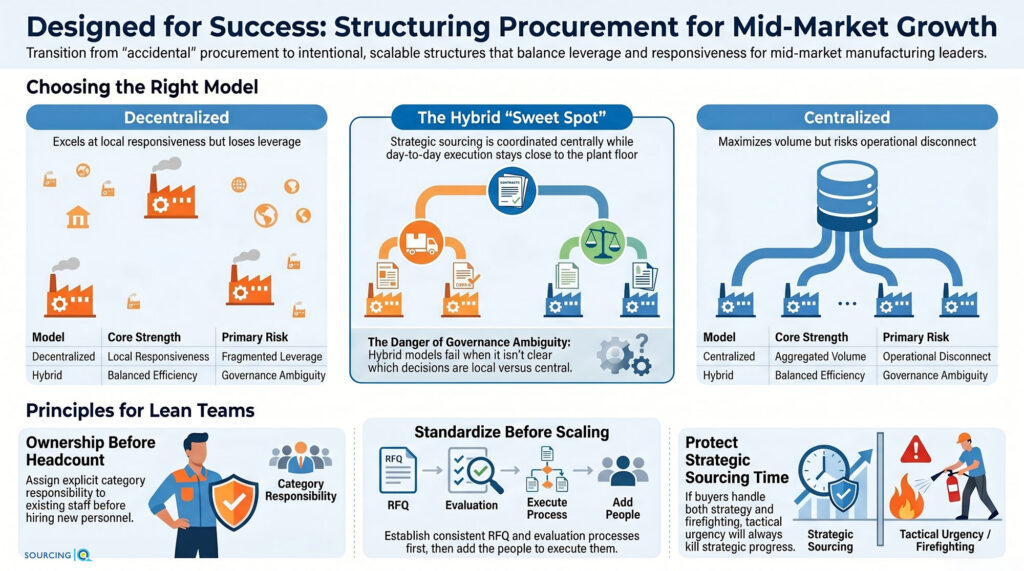
Most manufacturing procurement organizations operate within one of three broad models. Each has real strengths, real weaknesses, and a context where it works.
Decentralized procurement
In decentralized models, purchasing decisions live at the plant or business unit level. Each facility manages its own supplier relationships, negotiates independently, and makes sourcing decisions based on local priorities.
This model is common in mid-market manufacturers that grew organically across multiple sites, and it works well for operational responsiveness. Plant buyers understand production schedules, local supplier capabilities, and the specific requirements of their facility. When something goes wrong, they know who to call.
The structural cost is leverage. When plants buy independently, enterprise purchasing volume gets fragmented. Similar components get sourced from different suppliers at different prices. The organization is buying as if it’s ten small customers instead of one, which is often exactly what suppliers charge for.
Over time, decentralization also tends to produce supplier base proliferation, inconsistent commercial terms, and limited visibility across the organization. It’s not because anyone made bad decisions. It’s because the structure didn’t support coordination.
Centralized procurement
Centralized models consolidate strategic sourcing authority at the enterprise level. A central procurement function owns category strategies, manages supplier relationships, and sets purchasing standards. Plants execute within that framework.
The advantages are significant: greater leverage through aggregated volume, consistent pricing and terms, cross-plant visibility, and the ability to build and apply institutional sourcing knowledge across the organization.
The risk is operational disconnect. Manufacturing environments require technical familiarity, production awareness, and local responsiveness that purely centralized structures can underserve. When central procurement makes decisions without adequate input from plant operations, implementations fail. Suppliers get changed without considering qualification requirements, specs get standardized that shouldn’t be, and plants find workarounds rather than complying with central decisions they don’t trust.
Hybrid models
Most mid-market manufacturers ultimately land here because it’s the most realistic structure for organizations that need both leverage and operational responsiveness.
In a hybrid model, strategic sourcing is coordinated centrally — category strategies, supplier negotiations, spend visibility, sourcing standards — while operational execution stays close to the plant. Plant buyers continue supporting production and managing day-to-day supplier relationships. Central procurement defines the framework they operate within.
This structure works because it separates the decisions that benefit from enterprise coordination (supplier strategy, volume leverage, pricing standards) from the decisions that require local knowledge (day-to-day ordering, urgent sourcing needs, operational problem-solving).
The failure mode for hybrid models is governance ambiguity. When it isn’t clear what’s centralized versus local, both sides make conflicting decisions and neither works well. Structure without clarity is just complexity.
How Procurement Roles Evolve With Maturity
Procurement organizational design isn’t a static decision. Roles and structures that work at one stage of organizational maturity become constraints at the next.
In early-stage or less mature organizations, buyers typically handle everything simultaneously: placing orders, expediting, managing supplier relationships, sourcing new components, and resolving operational disruptions. Generalism is required by necessity — there aren’t enough people to specialize, and survival depends on flexibility.
As the organization grows and procurement begins maturing, responsibilities naturally start separating:
Category ownership emerges — specific buyers become accountable for defined spend areas rather than general purchasing across all categories. This is often the first structural shift that enables strategic behavior. When someone owns a category, they start building expertise, benchmarking suppliers, and thinking beyond the next purchase order.
Sourcing and buying functions separate — the work of running structured sourcing events and developing supplier strategies becomes distinct from the operational work of managing day-to-day purchasing. Mixing the two consistently means sourcing loses to urgency.
Supplier performance management formalizes — someone becomes explicitly responsible for tracking delivery, quality, and responsiveness, not just handling issues when they surface.
Analytics and spend visibility get dedicated attention — either through a role or through structured processes that ensure data stays current and actionable.
This evolution doesn’t require large teams. It requires role clarity — explicit ownership of each function, rather than everyone implicitly responsible for everything.
Why Lean Teams Often Struggle Structurally
The structural challenges in lean procurement organizations tend to cluster around the same issues:
Ownership is unclear. When procurement responsibility is distributed across operations, plant management, and buyers without explicit accountability, sourcing decisions default to whoever is available. Categories without owners don’t have strategies. Supplier relationships without owners don’t have performance expectations.
Procurement is buried inside operations. In many mid-market manufacturers, procurement reports through plant management or operations leadership rather than having independent visibility. This creates appropriate operational alignment, but it consistently subordinates strategic sourcing work to production priorities. Strategic sourcing never wins that competition.
Buyers are overloaded with transactional work. When the same people responsible for strategic sourcing are also managing purchase orders, expediting shipments, and handling supplier issues, the transactional work always takes precedence. Sourcing strategy becomes a “when I have time” activity, which means it almost never happens.
Escalation paths are informal. Supplier problems that can’t be resolved at the buyer level often get escalated through relationships rather than defined processes. This slows resolution and prevents the organization from building systematic approaches to supplier management.
These are organizational problems, not people problems. Most buyers in these situations are working hard and doing what the structure rewards. The structure rewards operational execution. Strategic sourcing doesn’t happen because nothing in the structure requires it.
What Lean Procurement Organizations Actually Need
The answer isn’t to have a larger procurement organization. Lean manufacturing environments don’t typically have the luxury of building enterprise-scale procurement departments, and they don’t need to.
What lean procurement organizations need is clarity and structure, not complexity and headcount:
Clear sourcing ownership. Explicit category accountability, even if informal. Someone responsible for machined components, someone responsible for electronics, someone responsible for packaging. Not everyone responsible for everything.
Standardized sourcing workflows. RFQ templates, evaluation criteria, and decision documentation that are consistent enough to produce comparable outcomes across events and buyers. The first structured event becomes the template for the next.
Spend visibility. Consistent access to supplier and category-level spend data that supports proactive sourcing decisions rather than reactive responses to supplier price increases.
Role clarity between strategy and execution. Even if one person does both, the activities should be recognized as distinct with protected time for sourcing strategy work that doesn’t get crowded out by operational urgency.
Escalation paths. Defined mechanisms for supplier issues that require management involvement, cross-plant coordination, or engineering input. This way, problems get resolved systematically rather than through whoever has the best relationship.
None of this requires a procurement transformation program. It requires intentional design decisions, even small ones, that create structure where structure currently doesn’t exist.
Organizational Design Principles for Mid-Market Manufacturers
The principles that tend to work in mid-market manufacturing procurement aren’t borrowed from enterprise models. They’re calibrated for lean organizations:
Centralize strategy, decentralize execution. Sourcing strategy and supplier standards benefit from enterprise coordination. Day-to-day purchasing and operational support belong close to the plant. Most mid-market organizations should be pulling more toward the center on strategy while protecting local execution capability.
Define category ownership before adding headcount. The biggest structural improvement most lean teams can make doesn’t require a new hire. It requires assigning explicit category responsibility to the people already in the organization.
Standardize before scaling. Adding sourcing resources into an unstandardized environment produces inconsistent results at higher cost. Establish consistent processes first, then scale the people executing them.
Match structure to complexity, not aspiration. Procurement organizational design should reflect where the organization actually is, not where leadership wants it to be. Over-engineering a structure for a $50M manufacturer doesn’t accelerate maturity. It creates overhead that slows execution.
Protect strategic sourcing time. Structural protections for sourcing work are more important than organizational charts. If the people responsible for strategic sourcing are also the people responsible for daily firefighting, strategic sourcing will lose every time without explicit prioritization.
Procurement Structure Determines Scalability
Headcount determines capacity. Structure determines whether that capacity produces consistent, compounding results or just keeps up with what’s urgent.
As mid-market manufacturers grow, procurement complexity grows with them. More plants, more categories, more supplier relationships, more acquisition integration. Without intentional structure, sourcing activity fragments at the same rate the organization expands. Each new plant becomes another decentralized buyer. Each acquisition brings a new supplier base that nobody coordinates.
With intentional structure, even a simple one, procurement can scale alongside the business. Category ownership creates accountability that transfers when people change roles. Standardized processes allow new facilities to be integrated without rebuilding from scratch. Centralized strategy ensures the organization’s purchasing leverage grows with its volume.
The strongest procurement functions in mid-market manufacturing aren’t the largest ones. They’re the most clearly organized ones — where sourcing ownership, supplier strategy, and operational execution are aligned well enough to produce consistent results, regardless of how lean the team is.