
Most plant buyers are excellent at their jobs. They know their suppliers, they understand production schedules, and they’ve developed the instincts to solve problems fast under real operational pressure.
What many of them were never taught is how to be strategic about procurement, i.e. strategic sourcing.
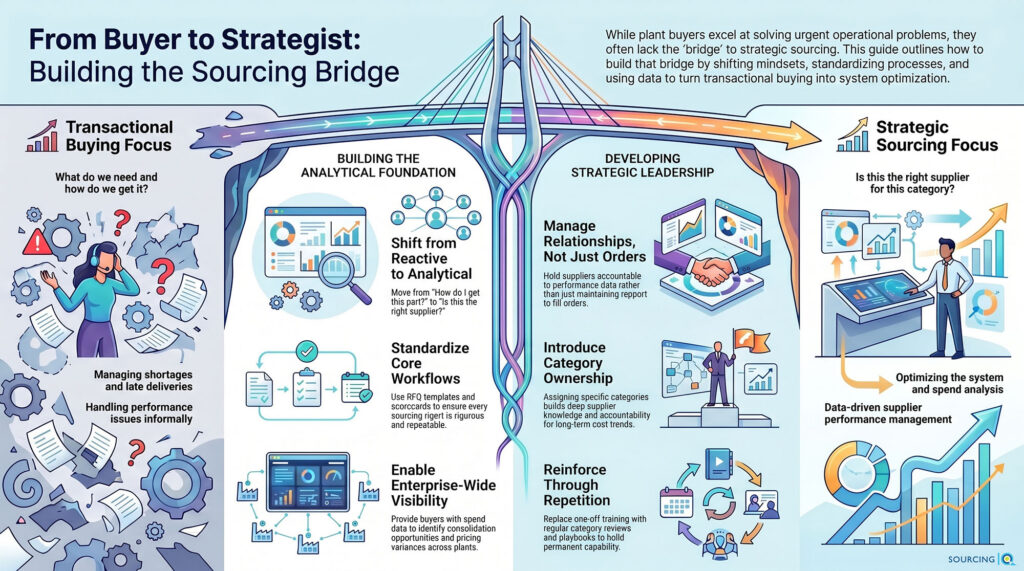
Plant buyers in manufacturing environments are typically developed to keep production running. That means managing shortages, expediting late deliveries, maintaining supplier relationships, and responding to whatever is urgent today. Those are genuinely valuable skills.
But they’re different from category strategy, sourcing leverage, spend analysis, and supplier performance management. And the gap between transactional buying and strategic sourcing is where most mid-market procurement organizations lose value. It’s not because the people aren’t capable, but because nobody built a bridge from one to the other.
The good news: that bridge can be built. Strategic sourcing thinking can be developed. The people most mid-market manufacturers already have are often the right people. They just need structure and development, not replacement.
Step 1 — Shift the Mindset from Reactive to Analytical
The first and most important change is how buyers think about their role.
Transactional buying starts with a need: production needs this part, find a source, place the order. The question is “what do we need and how do we get it?”
Strategic sourcing starts earlier and broader by asking: Is this the right supplier for this category? When was this relationship last tested against the market? Are multiple plants buying similar parts separately? Are we getting the best available price, or just a price?
The shift from “execute the transaction” to “optimize the system” is the foundation of everything else. It doesn’t happen through a training session. It happens when the organization starts asking buyers those questions and giving them the data and time to answer them.
Start by building it into routine conversations. In sourcing reviews, category discussions, and supplier meetings, introduce the analytical framing: What patterns are we seeing? Where are we fragmented? What hasn’t been sourced competitively recently? Over time, buyers who weren’t thinking this way start to do so because the environment reinforces it.
Step 2 — Standardize Core Sourcing Processes
Capability development is significantly harder when every sourcing event starts from scratch. Without consistent process structure, buyers default to whatever worked last time, which may or may not have been rigorous.
Standardizing core sourcing workflows gives buyers a framework to operate within and a baseline to improve against. The goal is repeatability, not bureaucracy.
What standardization looks like in practice:
- RFQ templates that define scope, volume assumptions, commercial terms, and supplier response format so every event produces comparable bids
- Supplier evaluation scorecards that create consistent criteria across categories and cycles
- Quote comparison formats that isolate cost drivers and make apples-to-apples analysis possible
- Savings tracking methods that tie results to specific actions and baselines
When processes are standardized, buyers can focus their energy on analysis and judgment rather than reinventing the wheel. They also learn faster because they can compare outcomes across events and understand what drove the difference.

We help manufacturers elevate procurement capabilities through proven sourcing frameworks and practical coaching.
Step 3 — Build Spend Visibility Into Daily Work
Plant buyers operating with limited data visibility are working with one hand tied behind their back. They may know their local suppliers deeply but have no view into how their categories look across the enterprise. This means they can’t see the consolidation opportunities, the pricing variance, or the fragmented spend that represent their biggest leverage points.
Introducing spend visibility doesn’t require sophisticated analytics infrastructure. Even relatively simple reporting can change behavior:
- Which suppliers account for the largest share of category spend?
- How does pricing for similar components compare across plants?
- Which categories haven’t seen a sourcing event in two or more years?
- Where is spend fragmented across too many suppliers?
Buyers who see these patterns regularly start asking different questions and making different decisions. Visibility connects individual purchasing actions to broader organizational outcomes, and that connection is what turns reactive buyers into strategic ones.
Step 4 — Develop Supplier Management Skills
Transactional buyers manage orders. Strategic sourcing leaders manage supplier relationships. The distinction matters more than it sounds.
Managing a relationship means holding a supplier accountable to defined performance expectations — on delivery, quality, responsiveness, and continuous improvement — not just maintaining enough rapport to get the order filled. It means having structured conversations about performance, not just phone calls when something goes wrong. It means making decisions about supplier allocation and development based on data, not familiarity.
These skills develop through exposure and practice, not classroom instruction. The fastest way to build them is to involve plant buyers directly in structured sourcing activities:
- Bring them into supplier evaluations so they understand what “good” looks like across dimensions beyond price
- Include them in RFQ review and negotiation preparation so they see how commercial decisions get made
- Have them lead supplier performance conversations with a framework and data, rather than handling performance issues informally
Operational involvement is what accelerates capability. Watching the process once builds awareness. Running it builds skill.
Step 5 — Introduce Category Ownership Gradually
Category ownership is one of the most effective tools for developing strategic sourcing behavior and one of the most underutilized in lean manufacturing organizations.
When a buyer owns a category, something changes. They start building deeper supplier knowledge. They develop opinions about the supply base. They notice when pricing hasn’t been benchmarked recently. They start thinking about the category as something to manage over time, not just a set of purchase orders to process.
Even modest category assignments create accountability that general purchasing responsibility doesn’t. The buyer becomes the person who knows that category best, who tracks its cost trends, who owns the sourcing strategy decisions.
In lean teams, category ownership doesn’t require restructuring. It requires assigning explicit responsibility and backing it up with the data access and process support buyers need to do it well.
Step 6 — Reinforce Capability Through Repetition
This is where most development efforts fall short. A training event, a workshop, or a single sourcing initiative builds awareness. Repetition builds capability.
The organizations that successfully develop strategic sourcing leaders don’t do it through periodic training programs. They do it through recurring structures that reinforce sourcing-oriented thinking as part of normal operations:
- Regular category reviews where buyers report on supplier performance, pricing trends, and upcoming sourcing opportunities
- Post-RFQ analysis discussions that examine what worked, what didn’t, and what would be done differently
- Sourcing playbooks that capture institutional learning so it doesn’t leave when a buyer changes roles
- Peer discussions that expose buyers to approaches from other categories and teams
Consistency matters more than sophistication. In lean teams, a monthly sourcing review and a library of reusable templates outperforms an annual training program with no operational follow-through.
Strategic Sourcing Leaders Are Built, Not Found
Most mid-market manufacturers already have people who understand their suppliers, production realities, and operational constraints deeply. That knowledge is genuinely valuable. It doesn’t need to be discarded; it needs to be built upon.
What many organizations lack isn’t talent. It’s a structured approach to developing the sourcing capabilities that talent is capable of.
Strategic sourcing leaders don’t typically arrive fully formed. They develop when organizations give people the right process structure, the right data visibility, the right category ownership, and the right reinforcement mechanisms. Then, consistently invest in developing sourcing-oriented thinking across the team.
That transformation doesn’t happen overnight. But it happens faster than most organizations expect, because the foundation — operational knowledge, supplier relationships, manufacturing instincts — is already there.
What’s missing is the structure to build on it.