
Which category should get sourced first? Which supplier is the biggest risk on the books? Where are costs actually rising, and where does it just feel that way? Which plants are buying the same thing from different suppliers without knowing it?
These are the questions procurement answers every week. The trouble is, most manufacturers are answering them with a mix of spreadsheets, tribal knowledge, and whoever happens to remember the last supplier conversation. The information exists. It’s just scattered across plants, systems, and people’s heads. Meaning, the picture procurement is working from is almost always incomplete.
That’s the gap procurement analytics closes. And it’s the thing that turns sourcing decisions from “this feels right” into “here’s what the data shows.” In direct materials procurement, analytics isn’t a side activity layered on top of sourcing. It’s the information layer underneath all of it.
Analytics Creates Visibility Into Where Your Money Actually Goes
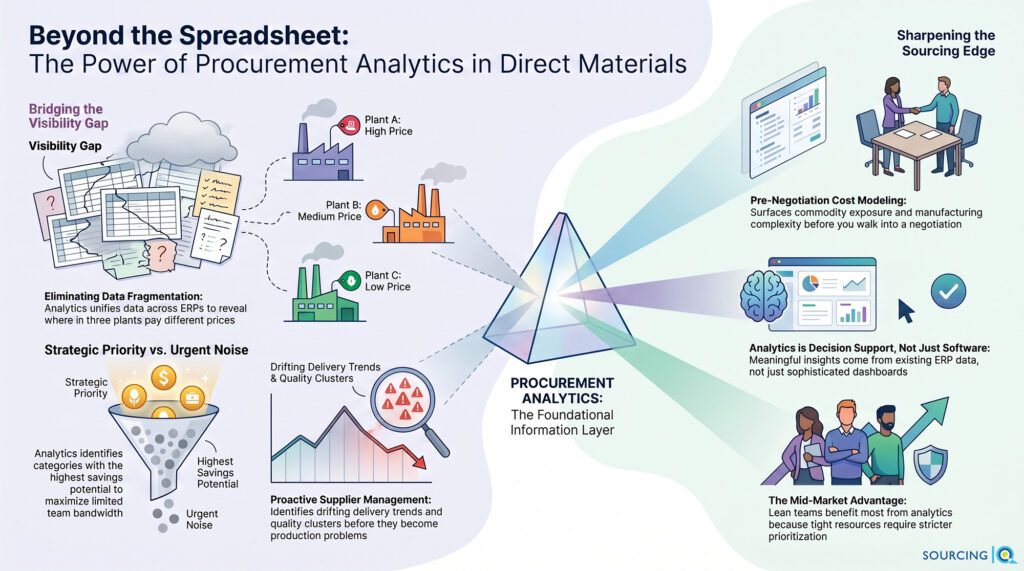
Most manufacturers have more procurement data than they realize. It’s just fragmented across plants, ERPs, and formats that don’t talk to each other. Analytics pulls that apart and answers the basic questions decentralized procurement can’t: where is spend concentrated, who are the suppliers behind it, which categories overlap across facilities, and where are three plants quietly paying three different prices for the same part.
That visibility is the difference between sourcing reactively and sourcing on purpose.
Analytics Tells You Where to Spend Your Limited Time
Every procurement team has more sourcing opportunities than bandwidth to pursue them. Analytics is what turns “where should we focus” from a guess into an answer by surfacing: which categories carry the biggest savings potential, where supplier concentration is creating risk, which categories haven’t been competitively sourced in years, and where pricing inconsistency is loudest.
That’s the difference between chasing whatever feels urgent this week and deploying a lean team where it actually moves the needle.
Analytics Sharpens Cost Modeling Before You Walk Into a Negotiation
Direct materials pricing is shaped by commodity exposure, supplier capacity, freight, manufacturing complexity, and demand swings — all moving simultaneously, none of it obvious from a quote sheet. Analytics surfaces the patterns: where commodity exposure sits within a category, how pricing has trended, what’s actually driving a supplier’s cost structure.
It doesn’t eliminate uncertainty in a negotiation. It eliminates walking into one blind.
Analytics Makes Supplier Management Proactive Instead of Reactive
The same data that powers sourcing decisions also exposes supplier patterns that are invisible plant-by-plant: delivery trends drifting in the wrong direction, quality issues clustering, and concentration risk building quietly across categories. Catching that early means addressing it before it becomes a production problem, not after.
Analytics Is What Makes the Rest of the Cluster Actually Work
Category strategy, RFQs, supplier initiatives — none of it runs on instinct alone. Analytics is the foundation underneath all of it: building sourcing roadmaps grounded in actual spend, justifying priorities to leadership with something more substantial than a hunch, and tracking whether sourcing initiatives delivered what they promised.
Three Misconceptions Worth Killing
“We need sophisticated software first.” Not necessarily. Plenty of meaningful insight comes from information already sitting in your ERP. The objective is better decisions, not a perfect dashboard.
“This is an enterprise thing.” Lean mid-market teams often get more out of analytics than large enterprises do, precisely because resources are tighter and prioritization matters more.
“Analytics means dashboards.” Dashboards are an output. Analytics is the decision support underneath them. The dashboard is just where you happen to look at it.
The Strongest Teams Aren’t the Ones With the Most Data
Direct materials sourcing is genuinely complicated. Multiple plants, multiple categories, multiple suppliers, market variables shifting constantly. Trying to navigate that without reliable information is how procurement ends up reactive by default.
The strongest procurement organizations aren’t the ones with the biggest data warehouse. They’re the ones who use the information they have to make sharper decisions faster. Analytics is the layer that turns sourcing from a series of educated guesses into a disciplined operational capability.