
Manufacturers usually turn to procurement when costs rise, supplier performance slips, or supply gets disrupted. That’s a fair instinct, because procurement owns the supplier relationships and the commercial negotiations.
But a lot of sourcing challenges start well before procurement ever gets involved.
Supplier options are shaped by where products get manufactured. Transportation costs follow plant locations. Lead times reflect production strategy. Engineering decisions determine which suppliers are even technically capable of producing a part. Inventory policy affects order quantities, freight cost, and how much flexibility a supplier actually has.
Procurement doesn’t operate independently of the supply chain. It operates inside a system that’s already been designed: for better or worse, deliberately or by accident. The manufacturers who consistently get better sourcing outcomes understand that relationship. They don’t treat procurement as a standalone function; they integrate sourcing decisions into how the supply chain itself is built, so the two reinforce each other instead of working at cross-purposes.
Procurement Works Within the System, Not Beside It
Sourcing teams are frequently asked to cut costs or improve supplier performance without anyone changing the conditions that created the problem. A team might be told to reduce freight while supporting a footprint that requires components to cross three borders. Or asked to shorten lead times while relying on suppliers halfway around the world. Or told to increase competition for a component engineered around one supplier’s proprietary process.
None of that is really a procurement problem. It’s a supply chain design decision that shows up on procurement’s desk.
Every manufacturer makes choices about plant locations, distribution networks, manufacturing processes, inventory strategy, product architecture, and supplier geography. Those choices define the environment procurement operates in, and the stronger the underlying system, the more effective sourcing can actually be.
Supplier Network Design Shapes What’s Possible
One of the biggest design decisions is the supplier network itself. Should suppliers be local, regional, or global? Is dual sourcing justified for a critical component? Should volume concentrate with fewer strategic suppliers, or spread across more vendors? Where should suppliers sit relative to plants? How much redundancy is the right amount?
Every one of those answers ripples into transportation cost, inventory levels, manufacturing flexibility, lead times, capacity availability, continuity, and commercial leverage.
Consolidating spend with one supplier can produce attractive pricing through volume and simultaneously increase dependence on one facility, one region, one production schedule. Keeping multiple qualified suppliers adds administrative complexity. And it can meaningfully improve resilience when something goes wrong. Neither answer is universally right. Effective procurement means understanding the tradeoff, not optimizing for a single metric and hoping it holds.
Direct Materials Sourcing Starts With Engineering
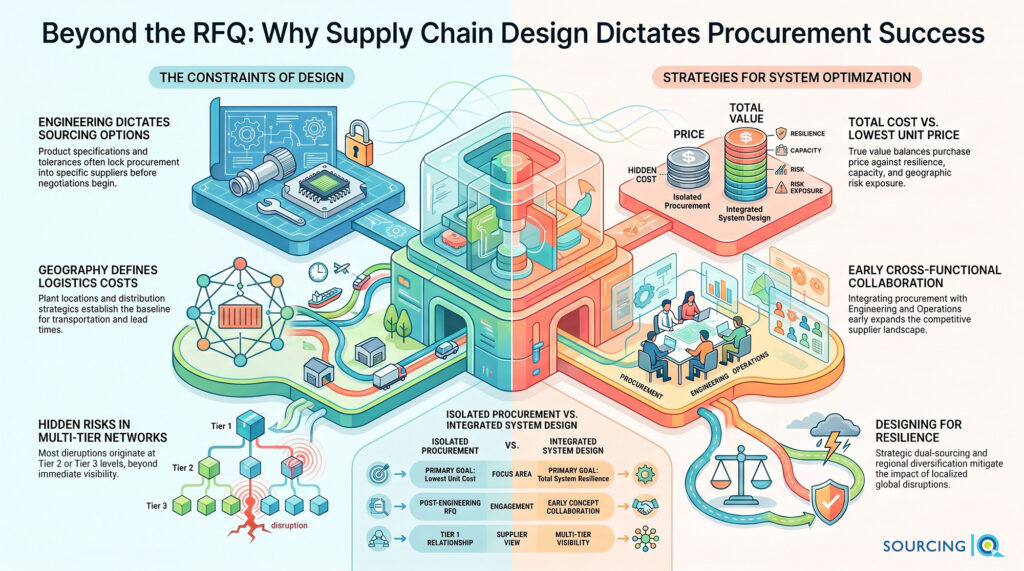
Some of the most consequential sourcing decisions get made before procurement issues an RFQ at all. Engineering shapes procurement every time it specifies materials, dimensions, tolerances, processes, and approved components.
A highly specialized design can limit sourcing options to a handful of qualified suppliers or fewer. Thoughtful standardization can open up the competitive field considerably. If engineering specifies proprietary components, unique materials, and extremely tight tolerances without commercial input, procurement may have almost no leverage once production starts. Earlier collaboration between the two functions can standardize materials across product families, reduce unnecessary machining steps, simplify fabrication, expand supplier competition, and improve manufacturability generally.
In that scenario, procurement contributes value before supplier selection even begins by helping shape the sourcing flexibility that engineering decisions determine.
Multi-Tier Visibility Matters More Than It Used To
Most manufacturers know their Tier 1 suppliers well: delivery performance, pricing, quality. What they often don’t know is the network sitting behind those suppliers.
Modern supply chains run through multiple tiers providing raw materials, castings, electronic components, fasteners, specialty chemicals, packaging, and subassemblies. Disruption several tiers upstream can hit production even when Tier 1 looks perfectly healthy. Recent global disruptions made this painfully clear. Shortages traced back to raw material producers, semiconductor manufacturers, transportation providers, and specialized subcomponent suppliers that most procurement teams had never directly assessed.
Complete tier-by-tier visibility isn’t realistic for most organizations. Understanding dependencies for strategically important materials and components is increasingly non-negotiable.
Cross-Functional Planning Produces Better Sourcing
The strongest sourcing organizations don’t make strategic decisions in isolation. Engineering brings technical requirements. Operations brings production priorities and scheduling reality. Quality brings process capability requirements. Logistics evaluates transportation strategy. Finance assesses commercial impact. Procurement integrates supplier markets, commercial strategy, and sourcing method.
When these perspectives combine early, the decisions get materially stronger. Engineering might identify a standardization opportunity across product lines. Operations confirms larger batches are feasible. Logistics recommends regional suppliers to cut freight exposure. Procurement then leverages the combined volume while expanding the competitive supplier set. No single function gets there alone.
Design for Resilience, Not Just Lowest Cost
Historically, a lot of sourcing teams chased the lowest unit price above all else. Cost still matters, but recent disruptions made clear it’s only one dimension. Manufacturers increasingly weigh supply assurance, geographic diversification, capacity availability, logistics risk, financial stability, continuity, and responsiveness to demand shifts alongside price.
The lowest-priced supplier isn’t the lowest total cost if disruptions trigger expedited freight, excess safety stock, downtime, or customer service failures. And concentrating production in one region can look efficient during stable conditions while quietly building exposure to weather, geopolitics, labor disputes, or transportation bottlenecks. Efficiency and resilience aren’t opposing goals — the strongest manufacturers design for both.
Common Design Mistakes
Optimizing only for unit price. A lower price doesn’t always mean lower total cost once transportation, inventory, quality, and operational risk enter the picture.
Treating procurement as the last step. Waiting until engineering finishes before bringing procurement in limits commercial flexibility that could have been designed in from the start.
Ignoring multi-tier dependencies. Understanding only direct suppliers leaves manufacturers exposed to disruptions further upstream.
Separating supply chain strategy from procurement strategy. When they evolve independently, the organization ends up with unnecessary complexity and conflicting priorities.
Strong Procurement Starts With Strong Supply Chain Design
Procurement teams select suppliers, negotiate agreements, and manage sourcing performance, but their effectiveness depends heavily on the system they’re operating inside. Manufacturers that integrate procurement into supply chain design make consistently better sourcing decisions, because engineering, manufacturing, logistics, supplier capability, and commercial strategy all get treated as parts of the same operating model.
The result isn’t just lower cost. It’s a supply chain better positioned to support production, absorb disruption, and hold a durable competitive edge.
The strongest sourcing organizations don’t ask procurement to work around the limits of a poorly designed supply chain. They design the supply chain so procurement can actually succeed.