The best supplier negotiations rarely start when both parties sit down at the table. They start weeks earlier.
By the time pricing discussions begin, the most effective procurement organizations have already analyzed market conditions, reviewed historical purchasing data, identified the major cost drivers, and built a working hypothesis for what a product should reasonably cost to manufacture. That preparation changes everything about the conversation. Instead of negotiating from a quoted price alone, procurement negotiates from an informed understanding of the economics behind it.
That’s the point of should-cost modeling.
Despite the technical-sounding name, it’s not a Fortune 100 cost-engineering exercise. It’s a practical sourcing capability that helps procurement professionals prepare better, ask sharper questions, and negotiate with actual confidence instead of a hunch. The goal isn’t to calculate exactly what a supplier should charge. It’s to understand enough about the product, the process, and the market to have a more productive commercial conversation.
Step 1: Decide Where It’s Worth the Effort
Not every purchase deserves a should-cost model. Building one for every SKU would burn resources and deliver almost nothing in return.
The strongest returns show up in high annual spend components, engineered direct materials, sole- or limited-source relationships, commodities with volatile input costs, strategic long-term supplier relationships, and categories with recurring negotiation cycles.
A commodity fastener from three distributors doesn’t need a should-cost model. A machined aluminum housing, a custom stamping, a precision casting, or an injection-molded part carrying seven-figure annual spend almost certainly does. Apply the tool where the potential commercial impact justifies the analytical effort — not everywhere.
Step 2: Understand What Actually Creates the Cost
Most negotiations start by staring at the quoted price. Should-cost modeling starts somewhere else entirely: what actually creates this cost?
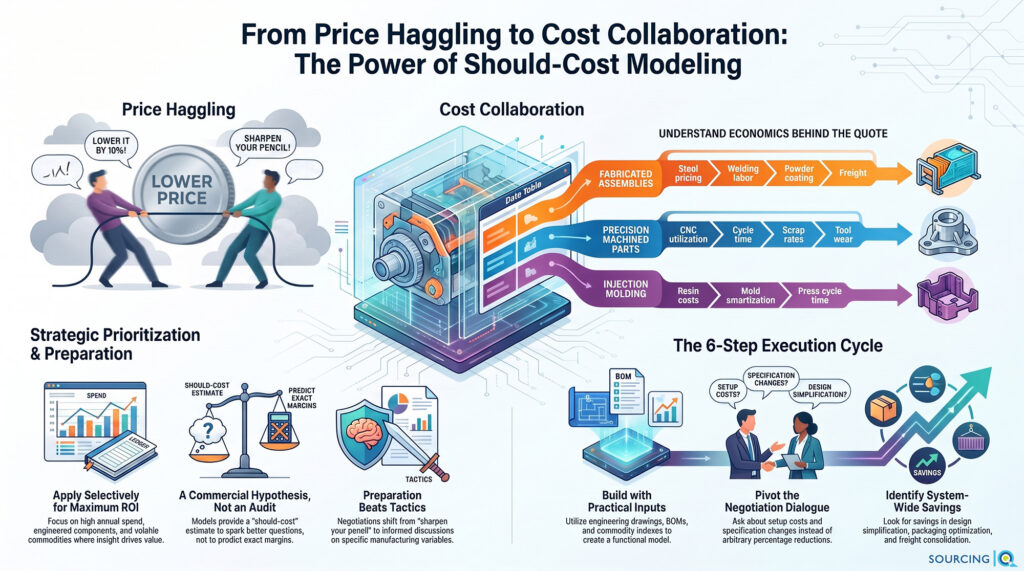
The answer depends on the process. A fabricated steel assembly is often driven by steel pricing, cutting or forming time, welding labor, surface treatment, and freight. A precision-machined component depends more on raw material yield, CNC utilization, cycle time, tool wear, inspection requirements, and scrap rate. An injection-molded part is shaped by resin cost, mold amortization, press cycle time, machine utilization, and packaging.
Every manufacturing process builds cost differently. Understanding that structure is worth more than knowing last year’s unit price. Procurement doesn’t need to become an engineering department, but the strongest sourcing professionals develop enough manufacturing fluency to know which variables actually matter for a given category.
Step 3: Build a Practical Model, Not a Perfect One
Useful inputs typically include engineering drawings, BOMs, historical pricing, commodity indexes, freight data, production volumes, supplier quotations, and cycle times and routings paired with internal engineering expertise.
Notice what isn’t on that list: perfect information. A should-cost model is a commercial estimate, not an accounting audit. Many teams avoid the exercise because they assume they can’t calculate exact manufacturing cost, but that’s not the bar. A model that reasonably estimates the major cost contributors is usually enough to strengthen the sourcing decision. The goal is understanding where the money is likely going, not predicting the supplier’s margin to the penny.
Step 4: Turn the Model into Better Questions
This is where the value actually lands.
Too many negotiations start with “can you sharpen your pencil” or “we need another five percent.” Those conversations end predictably: a small concession, some resentment, and nothing structurally different next cycle.
A should-cost model lets procurement ask about the assumptions behind the quote instead. Has steel actually moved the way this increase suggests? Did machining time change because of a spec revision? Would larger batch sizes reduce setup cost? Is there room to simplify the process? Could packaging be redesigned to cut logistics cost? Would a longer planning horizon improve their efficiency?
The shift from arguing about the number to understanding the variables that produced it changes the whole tone of the room. Suppliers rarely object to informed questions. Many welcome the chance to explain a legitimate cost driver, or to surface an opportunity neither side had considered. The conversation becomes collaborative instead of adversarial.
Step 5: Look Past Unit Price
One of the real strengths of should-cost modeling is that it surfaces savings that have nothing to do with price pressure. That might mean simplifying part geometry, reducing machining operations, standardizing materials across product lines, improving packaging efficiency, consolidating shipments, adjusting order quantities, or eliminating specs that never needed to be that tight in the first place.
Often the biggest savings come from changing the system, not squeezing the supplier’s margin. That’s why the strongest manufacturers pull engineering, operations, and quality into the sourcing process alongside procurement. Cross-functional collaboration finds opportunities that a pure price negotiation never will.
Step 6: Improve the Model Every Time
Should-cost modeling isn’t a one-and-done exercise. Every sourcing event generates new information: suppliers explain their assumptions, commodity markets shift, engineering revises the design, manufacturing improves.
The strongest procurement teams refine their models continuously, using awarded pricing, supplier feedback, commodity trends, and lessons from each negotiation. Over time the model gets less dependent on assumption and more grounded in actual commercial experience. Like any capability, it compounds with use.
Mistakes That Undercut the Value
Modeling everything. Reserve the detailed work for categories where it will actually change a sourcing decision.
Treating the model as gospel. Every model carries assumptions. It should guide the conversation, not dictate the conclusion.
Using it to prove the supplier wrong. The point isn’t to win an argument. It’s to understand the business well enough to ask a better question. Approached that way, should-cost modeling often strengthens the relationship rather than straining it.
Ignoring what the supplier knows. Procurement understands markets. Engineering understands requirements. Operations understands manufacturing. Suppliers understand their own production process better than anyone in the room. The strongest sourcing decisions pull from all four.
Better Negotiations Start with Better Understanding
Negotiations aren’t won through pressure. They’re won through preparation. Should-cost modeling moves procurement past debating a quoted price and into understanding the operational and economic reality behind it, and that leads to sharper questions, more productive supplier conversations, and decisions grounded in evidence instead of instinct.
The real value of should-cost modeling isn’t that it tells you what a component should cost. It’s that it gives procurement the standing to negotiate from knowledge instead of guesswork, a capability that keeps paying off long after any single negotiation ends.