
Ask two manufacturers if they practice strategic sourcing, and you’ll likely get the same answer: “Yes, absolutely.”
Look closer, and the resemblance usually ends there. One organization runs structured category strategies, performs should-cost analysis, pulls engineering in early, and works with suppliers collaboratively to reduce total cost. The other gets three quotes before cutting a PO. Both call it strategic sourcing. Their capabilities and their results aren’t remotely close.
That gap is what sourcing maturity measures.
Strategic sourcing isn’t a project or an annual savings push. It’s an organizational capability that develops over time through better process, stronger governance, sharper analytics, and more effective cross-functional collaboration. A sourcing maturity model gives manufacturers a practical way to see where they actually stand and what capability comes next.
Why This Matters Beyond the Scorecard
Manufacturers operate in genuinely complex supply environments: commodity prices move without warning, supplier capacity shifts, engineering revisions change requirements mid-stream, geopolitical events disrupt transportation, and customers want shorter lead times without giving up quality or price.
Organizations still running reactive purchasing struggle in that environment. Organizations with real sourcing maturity anticipate change, evaluate alternatives, and make disciplined decisions before problems compound. The payoff extends well past negotiated savings: more predictable cost outcomes, better supplier performance, lower supply risk, faster sourcing cycles, and more resilience when markets get disruptive.
Five Levels of Sourcing Maturity
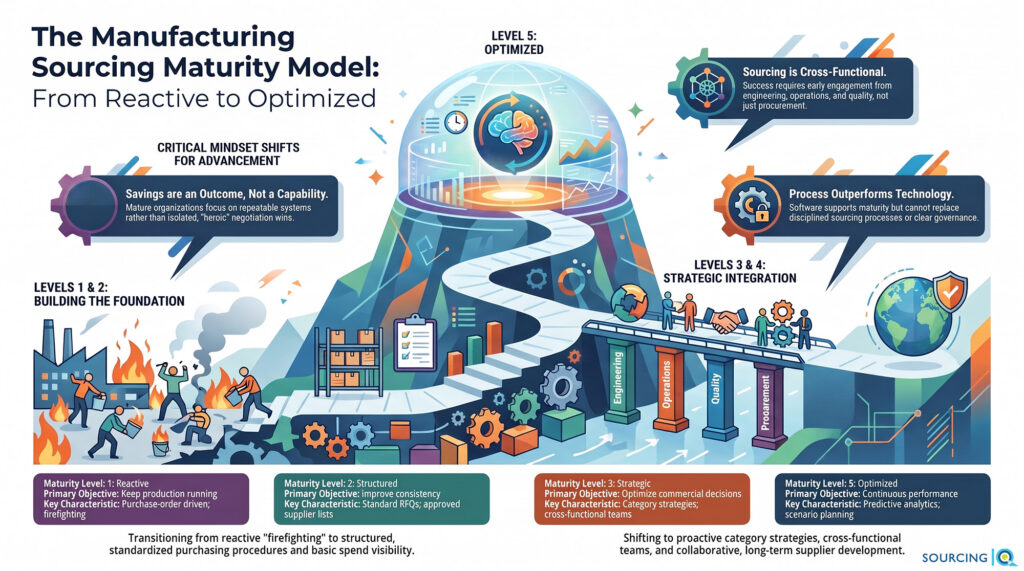
Level 1 — Reactive Buying. The objective is keeping production running. Purchasing is driven by immediate need, not strategy: frequent expediting, minimal supplier evaluation, little spend visibility, category planning that barely exists, supplier selection based mostly on who’s available. Success is measured by whether the part shows up before the line stops. Common in fast-growing companies or businesses dealing with constant disruption, but it produces inconsistent pricing and elevated risk almost by default.
Level 2 — Structured Purchasing. Basic consistency shows up: approved supplier lists, standard RFQ procedures, purchasing policies, basic supplier performance tracking, better documentation. The organization is more disciplined, but sourcing is still largely transactional. The shift is from “buy materials” to “buy materials consistently,” and that’s the operational foundation more strategic sourcing requires.
Level 3 — Strategic Sourcing. This is where sourcing becomes a business capability rather than a purchasing activity. Category strategies emerge. Cross-functional sourcing teams form. Competitive events become routine. Supplier segmentation replaces treating every supplier the same. Total cost thinking replaces unit price thinking. Engineering, operations, quality, and procurement start collaborating earlier in the process. Savings become more repeatable because sourcing follows a methodology rather than an individual buyer’s style.
Level 4 — Integrated Supplier Management. Selection is only the beginning; long-term value depends on how the relationship is managed after award. Quarterly business reviews, supplier development initiatives, joint continuous improvement work, performance dashboards, executive-level supplier engagement, risk monitoring, and collaborative forecasting all show up here. Procurement shifts from managing transactions to managing supplier performance and capability. Instead of replacing suppliers at the first sign of trouble, the organization works collaboratively on quality, delivery, cost, and efficiency. This turns supplier relationships into a competitive advantage rather than an administrative burden.
Level 5 — Continuous Sourcing Optimization. The top level is defined by continuous learning, not a finished state. Advanced procurement analytics, should-cost modeling, commodity market intelligence, predictive risk monitoring, scenario planning, formal sourcing governance, and knowledge management across teams all operate as a system rather than a series of isolated projects. Organizations here aren’t “done.” Markets shift, supplier capability evolves, and manufacturing technology improves. The objective is continuous adaptation, not perfection.
Assessing Where You Actually Are
Most manufacturers don’t fit neatly into one level. A company might be Level 4 in direct materials and Level 2 in MRO. Another might have sophisticated analytics and inconsistent governance.
Rather than asking “which level are we,” ask: Are our sourcing decisions proactive or reactive? Do key spend categories have documented strategies? Are engineering and operations engaged early? Do we actually understand supplier cost drivers? Is supplier performance systematically improved, or just managed reactively? Do reliable analytics support our decisions? Can our sourcing practices repeat across plants, or does it depend on one person?
Those questions reveal capability gaps far better than a savings report ever will.
Moving Up the Curve
Progress here is incremental, not a leap. For many manufacturers, the next step is simply improving spend visibility and documenting category strategies for the categories that matter most. For others, it’s formal supplier segmentation or stronger cross-functional collaboration.
Technology supports the effort: analytics platforms, sourcing software, supplier management tools all add real capability. But technology doesn’t create maturity on its own. Without disciplined process, clear decision rights, and organizational alignment, even sophisticated tools deliver limited value. Fix the system first. Use technology to scale it.
Mistakes That Slow the Climb
Treating savings as the measure of maturity. One great negotiation doesn’t make an organization mature. Consistent, repeatable improvement does.
Confusing activity with strategy. Running more RFQs isn’t the same as sourcing strategically. Real strategic sourcing requires structured analysis and cross-functional decision-making, not just more paperwork.
Expecting technology to fix process problems. Software improves visibility and efficiency. It can’t compensate for unclear governance or inconsistent decisions.
Building procurement in isolation. Manufacturing sourcing succeeds because engineering, operations, quality, finance, and procurement make better decisions together. Treating sourcing as procurement’s job alone limits how far the organization can go.
Build Capability, Not Just Savings
Savings are temporary. Capability is permanent. Every structured event, every category strategy, every supplier review contributes to an organizational capability that gets more valuable over time. It can respond to volatility, reduce total cost, and strengthen supplier relationships long after any single win.
A sourcing maturity model isn’t a grade. It’s a roadmap. The manufacturers who consistently outperform aren’t the ones who negotiate hardest. They’re the ones who keep improving the systems that produce their sourcing decisions, year after year.