
A real-time view of supply chain risk is no longer optional.
Over the past two weeks, global supply chains have entered a more fragile and reactive state driven by geopolitical escalation risk, shifting freight dynamics, and tightening commodity signals.
For procurement leaders, the challenge is no longer just cost optimization. It is decision-making under uncertainty, where timing, supplier strategy, and logistics planning can materially impact outcomes.
This update builds on our previous outlook by focusing on what has changed in the last two weeks—and what actions procurement teams should be taking now.
What’s Shifted in the Last Two Weeks
Strait of Hormuz risk went from hypothetical to actionable
The risk profile around the Strait of Hormuz has changed because routing delays and insurance-driven cost escalation are now live considerations rather than tail risks.
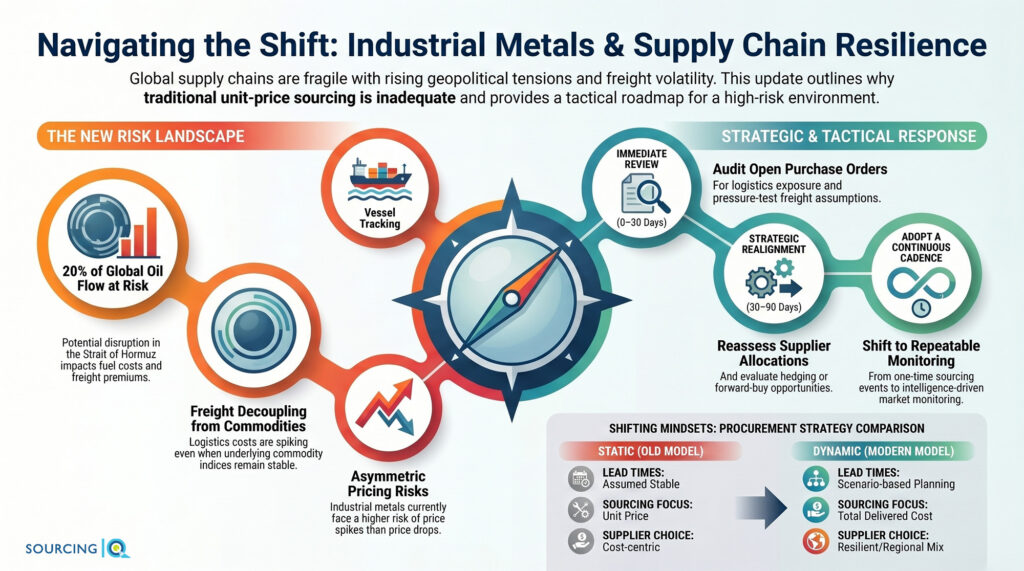
Why it matters operationally: roughly 20% of global oil flows through that corridor. Any meaningful disruption ripples into fuel costs, which ripple into freight rates, which embed themselves in your actual landed material cost — often before your commodity price indices show any movement at all.
The procurement implication here is subtle but important: you’re not just managing what you pay for a component. You’re managing logistics exposure that’s already priced into the quote you received last week.
Freight markets are moving faster than commodity prices
Ocean freight and related logistics costs are already showing sensitivity to geopolitical tension in ways that traditional commodity indices aren’t yet capturing. What’s visible: increased rate volatility on key lanes, early signs of carrier capacity tightening, and more aggressive fuel surcharge adjustments from carriers who are managing their own exposure.
The disconnect this creates is significant. A commodity price that looks stable on paper can arrive at your dock with a materially different landed cost than your model assumed — because freight moved while you were watching the metal price.
Sourcing strategies that focus only on unit price are now incomplete. Total cost has to incorporate dynamic freight assumptions, and those assumptions need to be revisited more frequently than most procurement calendars allow.
Industrial metals remain structurally supported
Short-term price movement may look muted depending on which index you’re watching. The underlying conditions haven’t changed: energy-linked production costs, regional capacity constraints, and stable industrial demand are all still present.
What has changed is the risk distribution. The floor has risen even if spot prices haven’t spiked. The market is increasingly asymmetric — there’s more upside risk to prices than there is downside relief. Procurement teams managing to a “prices will stay flat” assumption are carrying more exposure than the current numbers suggest.
What This Means for Procurement Strategy
Static sourcing strategies are now a liability
If your sourcing model assumes stable lead times, predictable freight, and gradual price movement, you’re working from a playbook that was written for a different environment. The current one requires scenario-based planning, dynamic supplier allocation, and shorter feedback loops between market intelligence and sourcing decisions.
That doesn’t mean constant firefighting. It means building a process that can incorporate new information and adjust — rather than one that assumes the last six months will look like the next six.
Timing is now a primary cost lever
In stable markets, timing optimization is a nice-to-have. In volatile ones, it becomes a first-order decision. Locking pricing too early creates downside exposure if relief comes. Waiting too long creates exposure to sudden escalation — which is the higher-probability outcome in the current environment.
The current bias is clear: the risk of an upside price shock is meaningfully higher than the probability of material downside relief in the near term. Teams that recognize that asymmetry can make better timing decisions than those treating uncertainty as symmetric.
Supplier strategy needs to extend beyond cost
Supplier selection conversations that used to start and end with unit price now need to account for geographic exposure to disruption, logistics resilience, and how a supplier actually responds when conditions change.
In practice, that’s increasing the strategic value of dual sourcing, regional diversification, and harder looks at incumbent supplier concentration. A supplier with slightly higher unit prices but better logistics resilience and geographic diversification may be the correct total-cost decision right now — even if the spreadsheet doesn’t immediately show it.
Tactical Actions Worth Evaluating Now
Near-term (0–30 days):
- Review open POs for logistics exposure — routes, carriers, timing assumptions
- Validate supplier commitments under disruption scenarios before they’re tested
- Pressure-test the freight assumptions embedded in current quotes
Mid-term (30–90 days):
- Reassess sourcing allocations across suppliers and regions
- Evaluate forward-buy or hedging opportunities where your category and risk tolerance support it
- Align internal stakeholders on where the organization sits on the risk-tolerance-vs-cost-optimization spectrum — because that tradeoff is now explicit, not theoretical
Ongoing:
- Establish a repeatable market monitoring cadence so you’re not starting from scratch every time conditions shift
- Integrate freight, commodity, and geopolitical inputs into sourcing decisions as a single picture, not three separate conversations
- Shift from treating sourcing as an event to managing it as a continuous process
Where Most Organizations Fall Short
Most procurement organizations still react to price changes after they occur, lack integrated visibility across supply chain variables, and treat sourcing as a periodic exercise rather than a continuous discipline. The result is missed timing opportunities, overexposure to volatility, and sourcing outcomes that are more luck than strategy.
That model worked reasonably well in stable markets. It’s increasingly costly in this one.
The Bottom Line
Supply chain risk is no longer episodic. It’s continuous — and the organizations that treat it that way will make systematically better decisions than those waiting for the next disruption to prompt a response.
This doesn’t require perfect market prediction. It requires structuring decisions so that you’re positioned correctly across a range of outcomes — not just the one that looks most likely today.
The last two weeks reinforced that. The next two probably will too.