Most mid-market manufacturers engaged in procurement capability building have experienced some version of this patter:
A sourcing initiative delivers real savings. Suppliers get renegotiated. Costs come down. The organization celebrates. And then, over the next 12 to 18 months, those gains quietly erode. New suppliers get added at the plant level. Pricing discipline fades. Processes drift back toward reactive purchasing. By the time anyone notices, a significant portion of the original savings has disappeared.
The sourcing strategy didn’t fail, but procurement capability did.
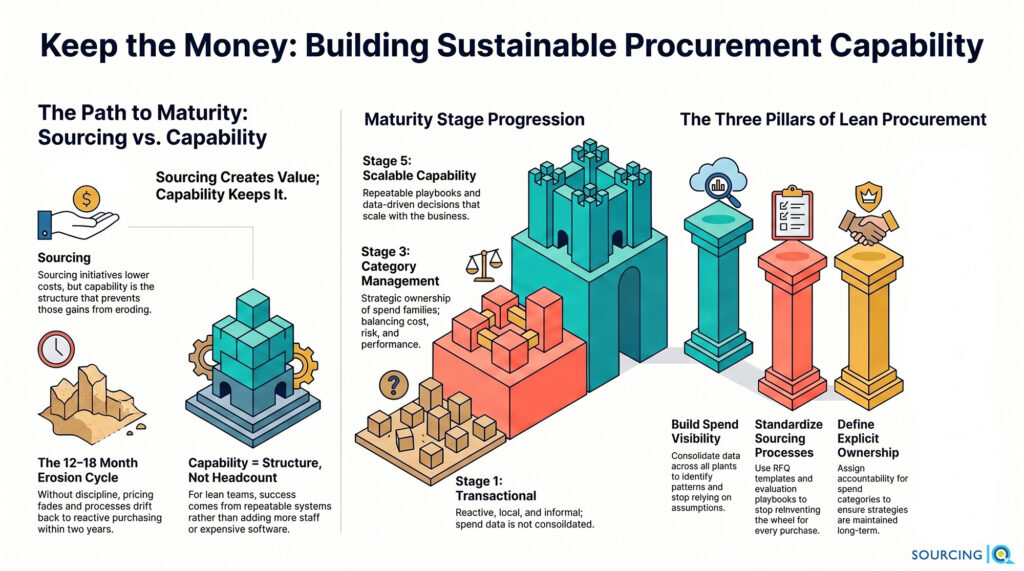
The difference matters. Sourcing initiatives create value. Procurement capability is what allows organizations to keep it.
For lean teams in mid-market manufacturing environments, capability building isn’t about adding headcount or deploying expensive systems. It’s about introducing structure, discipline, and repeatability into how procurement operates so that the work compounds instead of resets.
What Procurement Capability Actually Includes
Capability is the word that gets used vaguely in a lot of procurement conversations. It’s worth being precise about what it means in a manufacturing context.
Procurement capability is not primarily a function of negotiation skill or software tools. It’s a combination of organizational, process, and analytical elements that allow sourcing decisions to be made consistently, effectively, and at scale. In manufacturing environments, those elements typically include:
Spend visibility. The ability to understand where money is being spent — across suppliers, categories, and plants — consistently and with enough analytical structure to identify patterns and priorities. Without this, procurement strategy is built on assumptions.
Sourcing process discipline. Structured approaches to RFQs, supplier evaluation, award decisions, and contract management that produce comparable, defensible outcomes across categories and cycles. Not bureaucracy — structure that creates leverage.
Supplier management. Ongoing performance tracking, clear expectations, defined escalation paths, and relationship management that goes beyond keeping the supplier happy and extends to making sure they perform. Most mid-market teams underinvest here.
Category ownership. Clear accountability for sourcing decisions within defined spend areas. When everyone owns a category, no one does. When ownership is explicit, strategy is possible.
Data and analytics. The ability to analyze spend patterns, identify cost drivers, evaluate supplier performance, and surface opportunities on a repeatable basis, not just during a transformation project.
Organizational alignment. Coordination between procurement, operations, and engineering so that sourcing decisions reflect production realities and sourcing constraints get surfaced early in design and planning cycles.
Individually, these elements are useful. Together, they create a procurement function that operates consistently rather than reactively — one that gets better over time instead of cycling through the same problems.

The right processes, skills, and sourcing discipline can dramatically improve procurement performance. Let’s discuss your goals.
The Procurement Capability Gap in Mid-Market Manufacturing
Most mid-market manufacturers don’t start with a developed procurement function. They start with people solving problems.
Purchasing responsibilities often spread organically across plant-level buyers, operations teams, and engineering functions — each managing the supplier relationships relevant to their work, each optimizing for production continuity rather than strategic sourcing. That works, until the organization needs procurement to scale, sustain savings, or function as a value creation lever.
The patterns that develop in this environment are familiar:
Suppliers get added to solve immediate needs, not as part of a deliberate supply base strategy. Pricing gets negotiated locally by whoever needs the parts, which means similar components get different prices at different plants without anyone noticing. Sourcing processes vary across facilities because each plant has its own habits and relationships. Spend visibility is limited because nobody has consolidated the data or built the analytical infrastructure to see across the organization.
This model can support day-to-day operations. What it can’t do is produce repeatable savings, scale across a growing footprint, or sustain the improvements that sourcing initiatives generate.
The capability gap in mid-market manufacturing is less about individual talent than it is about structure. Smart, experienced buyers operating in an unstructured environment will produce inconsistent outcomes — not because they’re doing something wrong, but because the system they’re operating in doesn’t support consistency.
A Capability Model for Lean Procurement Teams
Procurement capability doesn’t appear all at once. It develops in stages, and understanding those stages helps organizations recognize where they are today and what needs to change to move forward.
Stage 1 — Transactional Purchasing
At the most basic level, procurement is reactive. Purchasing happens in response to production needs. Supplier relationships are local and informal, built on familiarity and responsiveness. Spend data exists but isn’t consolidated or analyzed. Sourcing is ad hoc — whoever needs the part makes the call.
This stage is common in smaller manufacturers and in plants within larger organizations that have grown faster than their procurement infrastructure. It works until it doesn’t — typically when cost pressure increases, a supplier fails, or the organization tries to scale.
Stage 2 — Structured Sourcing
As organizations begin to formalize procurement, basic structure appears. RFQs get used for significant purchasing decisions, even if inconsistently. Initial spend analysis is performed, at least at the category level. Supplier comparisons become more systematic. Early cost savings are captured through competitive events.
Procurement at this stage is still reactive in its timing but intentional in its process when it does act. The shift from Stage 1 to Stage 2 often happens in response to a specific cost pressure or leadership mandate. The organizations that stay at Stage 2 are the ones that capture the initial savings without building the infrastructure to repeat them.
Stage 3 — Category Management
Capability expands as procurement begins thinking in categories rather than individual transactions. Categories are defined and mapped to manufacturing reality, not accounting codes, but actual spend families that reflect how materials are sourced. Ownership for sourcing decisions is assigned. Category strategies emerge that balance cost, risk, and performance rather than defaulting to “lowest price.”
This is the stage where procurement begins to feel strategic rather than transactional. The team is making deliberate choices about the supply base, not just responding to what the plant needs today.
Stage 4 — Integrated Procurement
Procurement becomes coordinated across the organization. Cross-plant sourcing strategies are aligned. Supplier relationships are managed at the enterprise level not separately by each facility. Pricing and contracts are standardized where it makes sense. Procurement processes are consistent enough that decisions made in one plant inform decisions in others.
At this stage, procurement operates as a unified function rather than a collection of local activities. The leverage that comes from enterprise-level coordination starts to materialize, and the cross-plant sourcing opportunities that were invisible in earlier stages become actionable.
Stage 5 — Scalable Capability
At the highest level, procurement becomes repeatable and continuously improving. Sourcing playbooks are documented and reused across categories and cycles. Data-driven decision-making is standard, not exceptional. Supplier performance is actively managed with defined metrics, review cadence, and consequence. Procurement processes scale alongside the business, through organic growth and acquisition, without requiring reconstruction each time.
This stage is what “keep the money” looks like operationally. Sourcing events produce savings that persist. Process improvements compound. The procurement function earns organizational credibility that makes future initiatives easier to execute.
Most mid-market manufacturers are operating somewhere between Stage 1 and Stage 3. Getting to Stage 4 or 5 doesn’t require the resources of an enterprise procurement organization. It requires structure and intentionality applied consistently over time.
Why Lean Teams Struggle to Build Capability
The constraints are real and understanding them honestly is the first step toward addressing them.
Limited headcount. Procurement responsibilities are spread across multiple roles, often none of which carry “procurement” in the title. The buyers who should be building category strategies are managing purchase orders. The managers who should be overseeing supplier performance are troubleshooting shortages.
Operational pressure. In manufacturing environments, production continuity is the priority that overrides everything else. Strategic sourcing work consistently loses out to reactive firefighting, not because anyone disagrees it matters, but because the urgent always crowds out the important in lean teams without protected bandwidth.
Lack of structure. Without defined processes and templates, every sourcing event starts from scratch. Every RFQ is built from a blank document. Every supplier evaluation relies on whoever is doing it this time. The absence of structure means the absence of institutional memory. And institutional memory is what makes organizations get better over time.
Unclear ownership. When it isn’t explicit who owns a category, sourcing decisions get made by whoever is available or whoever has the relationship. Category ownership is a prerequisite for category strategy, and category strategy is a prerequisite for repeatable results.
The important insight here: capability gaps in mid-market manufacturing are almost never caused by a lack of expertise. They’re caused by a lack of structure. Smart, experienced procurement people operating without structure produce inconsistent outcomes. The same people operating with structure produce consistent ones.
How Lean Teams Actually Build Capability
Building procurement capability doesn’t require large teams, expensive systems, or multi-year transformation programs. It requires introducing a small number of foundational elements and applying them consistently.
Standardize sourcing processes. Define how RFQs are built, run, and evaluated. Create templates that make the next event easier than the last one. The goal isn’t to make the process rigid. It’s to make it repeatable so teams get better at it over time rather than reinventing it.
Build spend visibility. Create a clear, consolidated view of procurement activity across the organization: by supplier, category, and plant. This is the analytical foundation for everything else. Without it, prioritization is guesswork.
Define ownership. Assign explicit responsibility for major spend categories. This doesn’t require a new organizational structure, it requires clarity about who is accountable for which decisions and which results.
Develop repeatable playbooks. Document approaches that work: category strategies, RFQ templates, supplier performance review formats, bid evaluation models. Playbooks reduce reinvention and allow institutional learning to accumulate rather than disappear when people change roles.
Invest in targeted capability development. Not broad training programs, targeted development that addresses the specific gaps limiting performance. Plant buyers who understand how to build a clean RFQ and evaluate bids comparably are more valuable than the same buyers with generic procurement certifications.
None of this happens overnight. But none of it requires resources most mid-market manufacturers don’t have. It requires the decision to build capability deliberately, rather than hoping sourcing results will persist without the infrastructure to sustain them.
Capability as a Value Multiplier
The relationship between procurement capability and procurement outcomes isn’t linear — it’s multiplicative.
When capability is low, every sourcing initiative starts from scratch. Savings captured in one category don’t inform the next. Supplier performance that improves briefly reverts when attention shifts. The organization cycles through the same improvements repeatedly without compounding on them.
When capability is high, the opposite happens. Sourcing events get faster because the process is established. Savings persist because governance and compliance make exceptions harder than compliance. Supplier performance improves because management is consistent rather than reactive. Each cycle builds on the last.
This is what “Keep the Money” means operationally. Not just negotiating better, but building the infrastructure that prevents what was won from leaking back out.
For mid-market manufacturers, this distinction determines whether procurement is a recurring cost-reduction project or a durable operational advantage. The organizations that sustain savings over years aren’t necessarily better at negotiating than everyone else. They’ve built the capability to make results repeatable.
Capability Is How Procurement Scales
As manufacturers grow across plants, through acquisitions, and into new product lines, procurement complexity increases. The transactional model that worked for a single-plant operation becomes progressively more expensive to sustain and progressively less effective at capturing leverage.
Capability provides the structure that allows procurement to scale with the business rather than lag behind it. Category ownership creates accountability that doesn’t depend on one person knowing everything. Standardized processes allow new plants and teams to be integrated without rebuilding from scratch. Repeatable playbooks allow the organization to move faster because it isn’t reinventing the wheel each time.
Lean teams can achieve high levels of procurement performance. The constraint isn’t resources, it’s structure. With the right foundational elements in place, lean teams often outperform larger procurement organizations that operate without discipline, because structure multiplies effort rather than substituting for it.
The organizations that build sustained procurement advantage aren’t the ones that negotiate the best deal once. They’re the ones that build the capability to deliver consistent results, quarter after quarter, category after category, regardless of who is in the seat.