
As manufacturing organizations grow across multiple facilities, the same pattern shows up almost every time. Plant A is buying fasteners from one supplier. Plant B is buying the same fasteners from a different supplier, at a different price, on different terms. Nobody planned it that way. It just happened, one local sourcing decision at a time.
Eventually someone notices, and the question gets asked: should we combine this and run one RFQ across every plant?
The honest answer: it depends. Bigger isn’t automatically better. Some categories are excellent candidates for consolidated sourcing. Others get more complicated — and riskier — the moment you force them into a single event. The job isn’t to build the biggest possible RFQ. It’s to know which conditions actually create leverage and which ones just create headaches.
Why Manufacturers Reach for Consolidation
Multi-plant sourcing is fundamentally a leverage play. When every facility sources independently, the usual symptoms show up: fragmented volumes, inconsistent supplier agreements, pricing nobody can explain, and duplicated sourcing effort that nobody has visibility into.
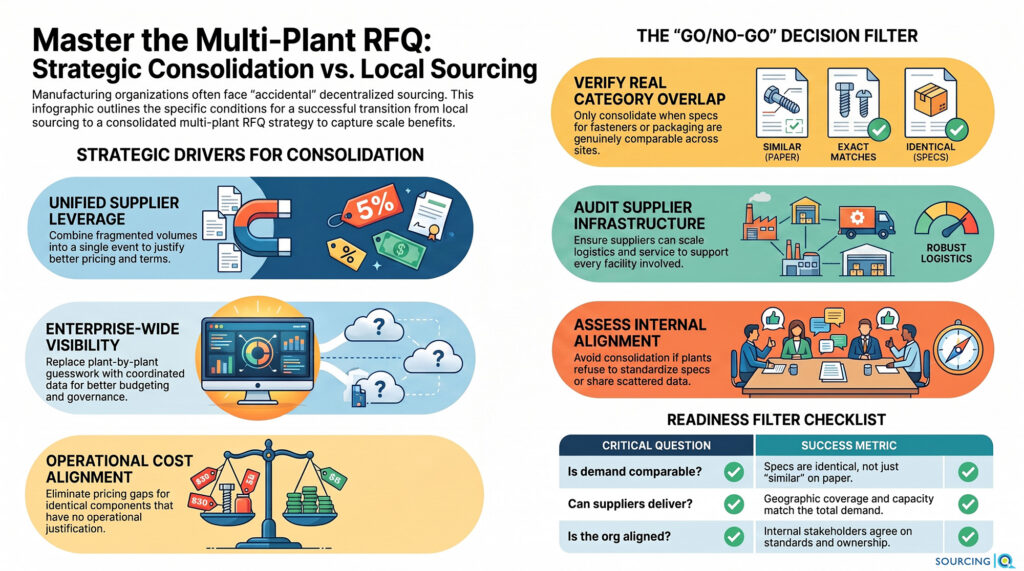
A multi-plant RFQ tries to fix that by combining requirements into one coordinated event. Done right, it tightens supplier leverage, improves pricing consistency, and gives procurement actual enterprise-wide visibility instead of plant-by-plant guesswork. Done wrong, it just creates a bigger, messier version of the same problem.
Consolidate When the Categories Actually Overlap
This is the easiest case to make. Standard fasteners, packaging, MRO supplies — these are categories where the specs are genuinely comparable across plants. Three facilities individually buying fasteners might each look like modest accounts to a supplier. Combined, that volume can justify pricing and service terms none of them could get alone.
The bigger the real overlap, the bigger the payoff. The operative word is real instead of “similar enough on paper.”
Consolidate When Suppliers Can Actually Service Multiple Sites
Volume means nothing if the supplier can’t deliver against it. Before consolidating, check geographic coverage, production capacity, logistics, and service responsiveness. A supplier that’s excellent for one regional plant may have zero infrastructure to support three facilities across four states.
Forcing that mismatch creates risk you didn’t have before. Multi-plant sourcing only works when supplier capability scales with the demand you’re handing them.
Consolidate When Pricing Is Inconsistent for No Good Reason
This is often the strongest signal in the entire evaluation. If identical components are priced differently across plants with no operational justification (just history, relationships, and decentralized negotiating) that’s leverage sitting on the table.
A multi-plant RFQ forces a side-by-side comparison that decentralized procurement never produces on its own. Beyond the savings, pricing alignment simplifies budgeting, reporting, and governance. Those benefits show up long after the RFQ closes.
Don’t Consolidate When the Requirements Are Genuinely Different
Specialized processes, region-specific regulatory requirements, dramatically different volumes. These are reasons to keep sourcing local, not problems to engineer around. Forcing fundamentally different requirements into one RFQ usually produces confused suppliers, weaker pricing assumptions, and an implementation headache nobody asked for.
Don’t Consolidate When the Organization Isn’t Aligned
Even categories with strong overlap fail when plants won’t standardize specs, procurement ownership is unclear, or supplier data is scattered across three different systems. At that point, the problem isn’t sourcing. It’s internal alignment, and no RFQ format fixes that.
A Five-Question Filter
Before aggregating anything, run the category through this:
- Is demand actually comparable, or does it just sound similar?
- Can suppliers genuinely support every facility involved?
- Is pricing fragmented without operational justification?
- Does consolidation reduce complexity or relocate it?
- Is internal alignment realistically achievable?
Categories that clear most of these are strong consolidation candidates. Categories that don’t are usually better left local. At least for now.
Scale Benefits Have to Be Designed, Not Assumed
Multi-plant sourcing is one of the more powerful levers available to manufacturing procurement when the conditions support it. It’s not created by combining spend on a spreadsheet. It’s created when demand is genuinely comparable, suppliers can actually deliver across sites, pricing fragmentation is real, and the organization can align around it.
The procurement teams that get this right aggregate on purpose — category by category, condition by condition. Because scale benefits in manufacturing procurement aren’t found. They’re built.