
In the first weeks after an acquisition, the integration agenda fills up fast: finance consolidation, leadership alignment, operational continuity, IT systems, HR. Procurement usually ends up somewhere near the bottom of that list to be addressed later once the “urgent” items are handled.
That sequencing can be a costly mistake.
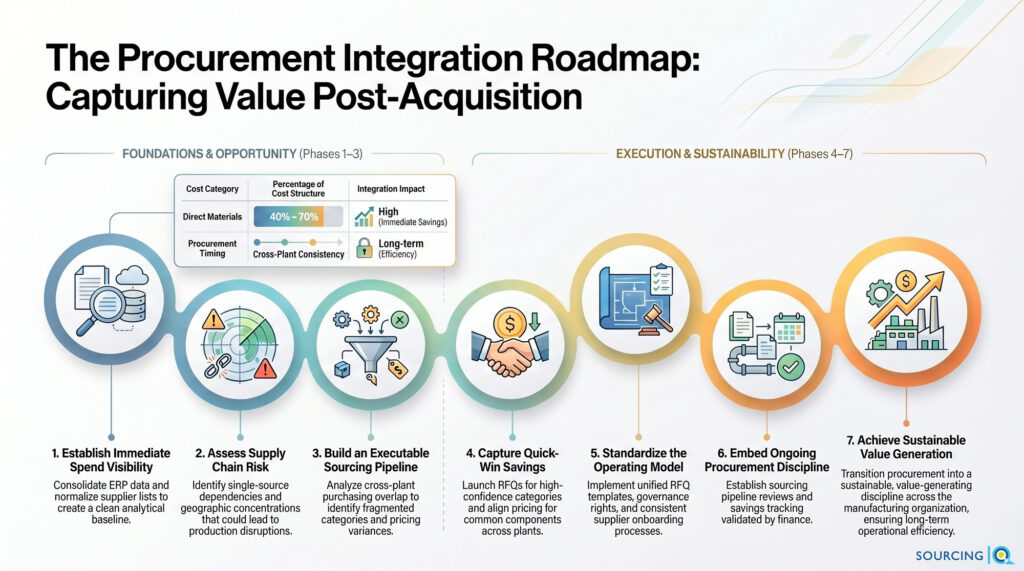
In manufacturing businesses, direct materials can represent 40–70% of cost structure. Procurement integration isn’t just an operational task — it’s one of the fastest paths to stabilizing supply, identifying savings, and building the foundation for structured sourcing. Leaving it until later means leaving value on the table during the window when it’s easiest to capture.
If you’ve never done one before, or need a refresher, this checklist organizes procurement integration into phases, from immediate visibility through sustained discipline. It’s designed to be usable right away.
Phase 1 — Immediate Visibility (First 30 Days)
Before anything else, you need to understand what you’ve actually acquired from a procurement standpoint. Most organizations underestimate how long this takes and how messy the data is.
- Consolidate supplier lists across all ERP systems and plants
- Normalize supplier naming conventions to eliminate duplicates (expect to find the same supplier listed five different ways)
- Extract the top 70–80% of spend by category — this is your analytical starting point
- Identify the highest-spend suppliers by volume
- Map direct materials categories at a high level: machined components, castings, fabrications, electronics, packaging, etc.
- Review current purchasing processes plant-by-plant — don’t assume they’re consistent
Outcome: A baseline understanding of supplier relationships, spend distribution, and how procurement actually operates today, not how the org chart says it should.

Procurement integration decisions made early can have lasting financial impact. We help teams execute faster and with less risk.
Phase 2 — Risk & Dependency Assessment
Spend visibility and supply risk aren’t the same thing. Once you can see the supplier base, the next job is finding where a disruption would do real damage.
- Identify single-source suppliers for critical or production-critical components
- Flag categories where the qualified supplier base is genuinely limited
- Assess supplier capacity constraints — who is running near full capacity, and what happens if demand increases?
- Review geographic concentration of the supplier base
- Identify components with long lead times or history of supply volatility
- Evaluate supplier financial stability where there’s meaningful concentration risk
Outcome: A clear picture of where supply disruption risk lives and where contingency planning is needed before you start running sourcing events.
Phase 3 — Opportunity Identification
With risk mapped, the focus shifts to value. This is where the sourcing pipeline gets built.
- Identify categories with fragmented supplier bases — more suppliers than the volume justifies
- Analyze cross-plant purchasing overlap — are multiple plants buying the same components independently?
- Compare pricing for similar components across facilities — price variance across sites is almost always an opportunity
- Flag categories that haven’t seen a competitive sourcing event in two or more years
- Review contract structures and expiration timelines — upcoming renewals are natural action windows
- Build an initial sourcing opportunity pipeline, sized and sequenced by impact and feasibility
Outcome: A prioritized list of sourcing opportunities with realistic savings estimates attached. Not a wish list, but an executable pipeline.
Phase 4 — Quick-Win Sourcing Actions
In PE-backed environments, early wins matter. They demonstrate procurement’s value, build organizational credibility, and create momentum for the broader integration effort.
- Launch RFQs for high-confidence categories — ones where specs are defined, the market is competitive, and switching risk is manageable
- Renegotiate pricing with key suppliers where legacy rates are clearly out of market
- Consolidate redundant suppliers in low-risk categories where the operational case is obvious
- Align pricing across plants for common components — cross-plant price variation is often the fastest win
- Capture and document savings as they’re realized, not retroactively
Outcome: Initial, verified cost savings and proof that procurement belongs in the value creation conversation from day one.
Phase 5 — Integration of Procurement Processes
Quick wins are tactics. This phase is about building the operating model that makes those wins repeatable.
- Implement standardized RFQ templates across the organization
- Align sourcing workflows across plants — decentralized doesn’t have to mean inconsistent
- Define procurement governance and decision rights: who approves awards, who owns exceptions, how plant-level purchasing relates to category strategy
- Establish category ownership — someone should be accountable for each major spend area
- Standardize supplier onboarding processes so new suppliers enter the system consistently
- Introduce consistent reporting mechanisms for spend, savings, and supplier performance
Outcome: A unified procurement operating model — not identical processes everywhere, but consistent enough to see across the organization and improve over time.
Phase 6 — Supplier Strategy Alignment
Procurement integration isn’t purely internal. The supply base needs to understand the new structure too.
- Define strategic vs. transactional suppliers — not all relationships deserve the same investment
- Align supplier expectations across plants: performance standards, communication norms, escalation paths
- Communicate procurement integration plans to key suppliers — surprises erode trust and performance
- Implement supplier performance tracking with defined metrics and review cadence
- Establish consistent evaluation criteria so supplier decisions are made on data, not relationship history
Outcome: A more coordinated and strategically aligned supplier base — one that understands who it’s dealing with and what’s expected.
Phase 7 — Establish Ongoing Procurement Discipline
Integration isn’t finished when the quick wins are captured. The final phase converts integration work into a sustainable capability.
- Establish a sourcing pipeline review cadence — treat it like a business process, not a special project
- Define a savings tracking methodology that finance will recognize and validate
- Implement ongoing spend analysis processes so visibility doesn’t degrade over time
- Schedule periodic category reviews — markets change, supplier performance shifts, pricing drifts
- Maintain supplier performance monitoring on a defined schedule
- Continuously evaluate new sourcing opportunities as the business evolves
Outcome: A procurement function that runs as a repeatable discipline instead of a series of one-off efforts that require rebuilding every time leadership changes or a new acquisition arrives.
Procurement Integration Creates the Foundation for Value
Procurement integration is one of the most underleveraged value creation levers in post-acquisition manufacturing environments. Done early and systematically, it produces more than cost savings — it builds the organizational capability that makes those savings durable.
What structured integration delivers:
- Visibility into direct materials spending that didn’t exist before
- Clarity on supplier relationships across the acquired business
- A live pipeline of sourcing opportunities with defined next steps
- A foundation for procurement to function as a strategic discipline rather than purchasing administration
In PE environments, where value creation timelines are compressed and operating partners need to demonstrate impact quickly, procurement integration is both immediate and lasting. Use the above is a starting point. The specific sequence and emphasis will vary by business. But the phases don’t change much, and neither does the payoff from getting them right.