
Manufacturers are under constant pressure to reduce costs, stabilize supply, and improve operational performance. Procurement sits in the middle of all three—acting as both the glue for the business and the captain of the performative ship.
So when internal teams can’t get consistent results (or can’t get enough bandwidth to go beyond daily cost/savings battle), leaders start looking at procurement consulting for manufacturers.
Here’s the problem: most procurement consulting content on the internet is either:
- written for massive enterprises with armies of category managers, or
- centered on indirect spend, corporate purchasing, and software-led “transformations.”
That’s not the world most mid-market industrial teams live in.
Manufacturing procurement is different. Direct materials aren’t “spend categories.” They’re production inputs. If you get them wrong, the line stops, the customer yells, and your “savings” shows up as premium freight and quality escapes.
We want to provide you with a practical guide to what effective manufacturing procurement consulting actually looks like—what to expect, where traditional approaches fall short, and how to choose a partner that can operate in plant reality (not just planning).
Why Procurement Consulting Looks Different in Manufacturing
A lot of consulting frameworks assume procurement is mostly about policy, approvals, and negotiating better rates. That can be true in indirect spend. But manufacturing procurement is built around a different set of physics:
Direct vs. indirect: not the same sport
Direct materials—the components, raw materials and subassemblies that go into the product—directly affect:
- COGS and margin
- Production uptime and schedule adherence
- Quality and warranty exposure
- Customer delivery performance
In other words: you can’t optimize procurement in a vacuum. Manufacturing procurement decisions have operational consequences, and the best consultants understand that up front.
Production-critical supply categories change the definition of “best”
In manufacturing, “lowest price” is rarely the same thing as “best outcome.” A sourcing decision that looks great on paper can become a disaster in the plant if it ignores:
- qualification timelines
- tooling costs and capacity constraints
- change control requirements
- supplier process capability
- lead-time reliability
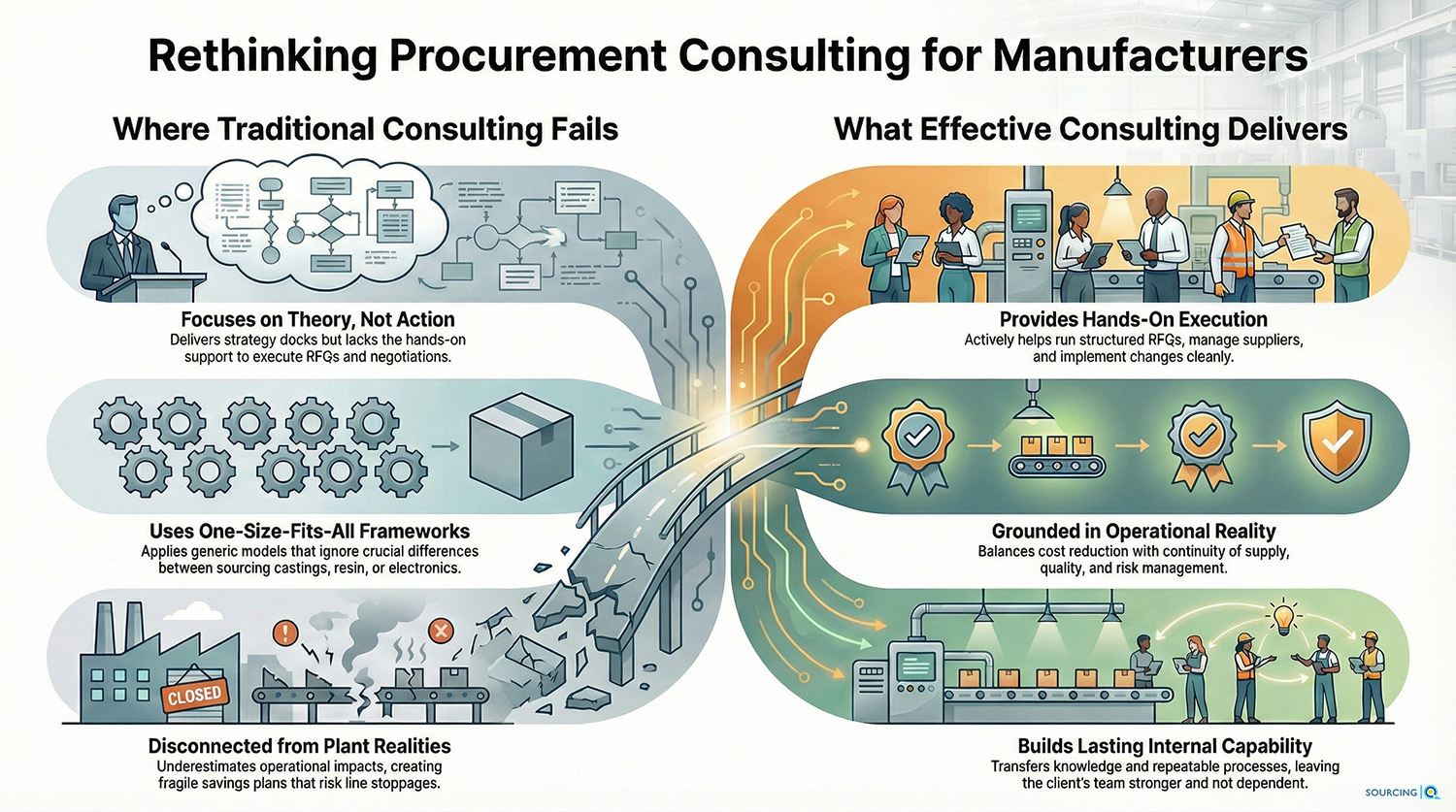
Effective consulting in industrial environments balances cost reduction with continuity of supply, quality, and risk management—not because it sounds mature, but because production forces it.
Multi-plant and HMLV environments don’t tolerate one-size-fits-all
If you’re in a multi-plant footprint, or you run a high-mix/low-volume environment, procurement complexity scales fast because:
- plants have different supplier preferences
- parts look “similar” but aren’t interchangeable
- spend is fragmented across ERPs, buyers, and local workarounds
Manufacturing procurement consulting must be tailored to how sourcing actually happens across plants, categories, and programs. Otherwise it becomes a corporate exercise that doesn’t stick.
Common Procurement Challenges Facing Manufacturers
Even well-run manufacturers tend to encounter the same procurement bottlenecks—not because they’re incompetent, but because industrial systems evolve faster than procurement structure.
Fragmented supplier bases
Suppliers get added over time at the plant or buyer level. The outcome is predictable: redundancy, inconsistent pricing, and limited leverage.
What that looks like in practice:
- five suppliers for similar machined parts
- three price levels for the same material spec
- “preferred” suppliers that are really just “familiar” suppliers
A consulting partner should help rationalize the supply base without creating operational risk (more on that later).
Legacy pricing and long-standing relationships
Relationships matter in manufacturing. The downside is that relationships often outlive reality. Volumes change. Specs change. Input costs change. The price… somehow stays the same.
Effective consulting helps manufacturers reintroduce market tension and cost-driver transparency without burning bridges or turning every conversation into a hostage negotiation.
Inconsistent sourcing processes (aka “every plant is its own universe”)
RFQs, negotiations, and supplier selection often happen differently across plants and categories. That inconsistency reduces transparency and makes it hard to scale improvements.
If you can’t explain how awards happen or why suppliers are chosen, you can’t repeat success—only happy accidents.
Limited spend visibility
Most manufacturers have spend data. What they don’t have is spend clarity.
Data lives in multiple systems where supplier names are inconsistent and categories don’t map to sourcing reality. So identifying high-impact opportunities becomes harder than it should be.
Lean teams stretched thin
Mid-market procurement teams are often capable and experienced—but buried. When you’re fighting shortages, expedites, and supplier issues all day long, strategic sourcing becomes a “next quarter” task… forever.
This is one of the best reasons to bring in help: not because the team lacks talent, but because it lacks breathing room.
Where Traditional Procurement Consulting Falls Short
A lot of manufacturers have a similar consulting story:
- engagement starts with promise
- outputs are polished
- results are… underwhelming
That usually comes down to misalignment with manufacturing reality.
Overemphasis on strategy decks
Many engagements produce detailed analyses and recommendations—but stop short of hands-on execution support.
In manufacturing, “recommendations only” is another way of saying:
“We gave you a map. Good luck crossing the swamp.”
One-size-fits-all frameworks
Generic procurement models rarely account for category-specific constraints, production dependencies, or supplier market dynamics.
If the framework doesn’t change whether you’re sourcing castings vs. resin vs. electronics, it’s not a framework—it’s guesswork.
Limited hands-on execution
Without direct involvement in RFQs, negotiations, and supplier engagement, recommendations remain theoretical.
This matters because savings in manufacturing don’t come from knowing what to do. They come from doing it cleanly and in concert:
- writing a structured RFQ
- getting comparable bids
- running a decision process
- implementing awards (the part everyone forgets)
- stabilizing supply so ops trusts the change
Misalignment with plant-level realities
Consultants who lack manufacturing experience often underestimate the operational impact of sourcing decisions.
If a consultant can’t talk credibly about line stoppages, qualification processes, PPAP/FAI-style gates, tooling, or lead-time variability, their savings plan will be fragile at best.
What Effective Procurement Consulting for Manufacturers Actually Includes
So if traditional consulting falls short, what does good procurement consulting look like?
Effective manufacturing procurement consulting is operationally grounded, execution-oriented, and aligned to production realities—not generic, enterprise-focused models.
Here are the core elements that should show up in an effective and trustworthy industrial consulting engagement.
Spend visibility and opportunity assessment
This is where smart engagements start: understanding where money is actually being spent and what is controllable.
A practical opportunity assessment should deliver category-level visibility that highlights:
- total spend by supplier and category
- fragmentation and leverage opportunities
- categories with the greatest cost or risk exposure
The best outcome isn’t a perfect spend cube. It’s a prioritized plan: These are the top categories to attack; here’s why; here’s what it will take; here’s the expected impact; here’s what could go wrong.
This “find the money” step sets up everything that follows.
Direct materials strategic sourcing
Direct materials is where manufacturing economics live. Effective consulting focuses on categories where cost, risk, and performance matter most—not just what’s easiest to bid.
What this includes in real life:
- category strategies aligned to business and operational priorities
- supplier base rationalization where appropriate
- competitive sourcing events where the market supports it
- commercial terms aligned with operational requirements (lead time, inventory models, surcharges, tooling ownership, etc.)
Importantly, strategic sourcing must be repeatable. If the engagement “works” only because a consultant ran everything, you didn’t build value—you rented it.
RFQ and sourcing event execution
RFQs are where strategy becomes real—or dies quietly.
Effective consulting includes hands-on support to:
- structure RFQs for comparability
- manage supplier communications and Q&A
- analyze bids and isolate cost drivers
- support negotiations and supplier selection
This matters because “we sent it out for quote” is not the same as “we created leverage.”
A structured RFQ contains:
- clear scope and volumes
- standardized bid fields (price, tooling, MOQ, lead time, indexing, incoterms)
- explicit assumptions
- a real timeline and decision logic
Done well, RFQs create market clarity and negotiating leverage. Done poorly, they create confusion, delays, and suppliers hedging their bids “just in case.”
Supplier performance improvement
Price alone doesn’t define supplier value. In manufacturing, performance is value.
Consulting should help manufacturers establish expectations and routines around:
- on-time delivery
- quality and defect rates
- responsiveness and communication
- continuous improvement initiatives
This is also where procurement and operations stop arguing and start cooperating—because the conversation shifts from “you picked a cheap supplier” to “we agreed on performance metrics, and we manage them.”
The Role of Consulting in Lean Procurement Organizations
Most mid-market manufacturers don’t need consultants because they lack competence. They need consultants because they lack capacity and need better clarity.
In lean procurement organizations, external support works best when it:
Augments internal resources during high-demand periods
Think of consulting as surge capacity for:
- major sourcing waves
- supplier transitions
- rapid opportunity assessments
- post-merger or PE portfolio initiatives
If procurement is stuck in daily execution, a consultant can create space for strategic work without starving the plant.
Provides structured processes and templates
Repeatability is what scales. Practical artifacts (RFQ templates, bid analysis tools, supplier scorecards, transition checklists) reduce reinvention and increase consistency across plants.
Transfers knowledge and builds internal capability
The goal is capability, not dependency. Your team should exit a consulting engagement faster and sharper than when they entered it:
- better at running events
- better at negotiating with cost drivers
- better at supplier performance routines
- better at prioritizing categories
Avoids creating long-term dependency
If the consulting model requires the consultant to remain forever, it’s not consulting. It’s outsourcing with nicer fonts.
How Procurement Consulting Supports Cost Reduction and Risk Management
Cost reduction is often the initial driver for bringing in a consultant. But in manufacturing, the best savings programs also reduce risk and improve predictability.
Cost levers beyond negotiation
Good consultants don’t just “negotiate harder.” They help unlock multiple savings levers:
- competitive sourcing where the market supports it
- volume aggregation and rationalization across plants
- spec and packaging standardization (often in partnership with engineering/ops)
- commercial terms optimization (surcharges, indexing, payment terms)
- supplier development and process improvements that reduce total cost
Negotiation is a tool. The system is the strategy.
Risk reduction through sourcing discipline
In direct materials, risk is not theoretical. It’s line stoppage, late shipments, and customer dissatisfaction—all leading to bigger problems if not addressed.
Consulting can reduce risk by improving:
- supplier strategies (single vs. dual sourcing where appropriate)
- qualification and transition planning
- lead-time reliability and communication cadence
- performance management routines
This is why manufacturing-specific consulting matters: it has to protect uptime while improving economics.
Better predictability and governance
Procurement consulting can also strengthen governance and discipline:
- clearer award logic and approval pathways
- fewer exceptions and “plant-only deals”
- better alignment with finance on savings tracking
That’s how savings becomes real, measurable, and sustainable—not just “estimated.”
Choosing the Right Procurement Consulting Partner
Not all consultants are a fit for manufacturing. When evaluating partners, industrial teams should look for signals that the consultant can operate in your environment—not just analyze it.
1) Manufacturing experience (not just “supply chain”)
Ask for relevant examples:
- multi-plant sourcing programs
- direct materials categories similar to yours
- transitions that required qualification/tooling
- supplier performance improvement work
If all examples are indirect spend or corporate purchasing, be cautious.
2) Direct materials expertise
Your partner should understand direct materials as a manufacturing system: cost drivers, market dynamics, and operational constraints.
3) Execution capability
The real question: Will they help run the work?
Look for evidence of hands-on RFQ execution, supplier engagement, negotiation support, and implementation planning—not just analytics.
4) Practical frameworks you can sustain
Frameworks are fine. What matters is whether your team can run them when the consultant is gone.
5) Cultural and operational fit
Manufacturing teams are skeptical for good reason. Consultants who talk like they’ve never been in a plant won’t get traction. The right partner respects operations, communicates clearly, and builds trust across procurement, engineering, and plant leadership.
Where Consulting Adds the Most Value (And Where It Doesn’t)
A quick truth that saves everyone time:
Consulting adds the most value when…
- you need surge capacity to run sourcing waves
- you need structured spend visibility and prioritization
- you want repeatable RFQ execution and supplier transitions
- you need help building procurement capability and discipline
Consulting adds less value when…
- you’re primarily looking for “industry benchmarks” with no plan to execute
- internal stakeholders won’t support change (plants override awards, engineering won’t engage, finance won’t validate) no matter what the recommendations are
- you want software to magically fix process gaps
Consulting is not a substitute for internal alignment. It’s an accelerator when alignment exists—or a catalyst to help build it.
Final Thoughts: Procurement Consulting Should Deliver Results, Not Just Recommendations
Procurement consulting can be a powerful lever for manufacturers—but only when it’s grounded in operational reality and focused on execution.
The best manufacturing procurement consulting looks like:
- clear spend visibility and opportunity focus
- direct materials sourcing built around real category constraints
- disciplined RFQ execution that creates leverage
- supplier performance routines that improve continuity and reduce risk
- capability building that leaves your team stronger, not dependent
If you’re evaluating consulting support, start by getting clear on your top 3–5 direct materials categories and the constraints that govern them. In manufacturing procurement, clarity isn’t a nice-to-have. It’s leverage.
For a direct materials foundation, read Direct Materials Strategic Sourcing: The Complete Guide for Mid-Market Manufacturers
Are you looking for capability without dependency? Learn more about SourcingIQ’s training