
A supplier starts slipping. Deliveries get unreliable. Quality issues creep up. Communication turns slow and defensive. And almost reflexively, the conversation inside procurement turns to one question: is it time to find someone else?
Sometimes, yes. Often, no. A lot of supplier performance problems are genuinely fixable, but only if you treat improvement as a structured process instead of an escalation reflex. The procurement organizations that get the most out of their supplier base are the ones who know how to fix what’s actually broken before reaching for the re-sourcing button.
Here’s the practical playbook.
✓ Diagnose the Actual Problem, Not the Vague Version of It
“Poor performance” isn’t a diagnosis. It’s a shrug. Late deliveries, quality defects, weak communication, capacity constraints, pricing disputes, slow response to engineering changes — they’re all different problems with different fixes. A delivery issue rooted in capacity constraints gets solved completely differently than one rooted in your own forecasting. Name the actual problem before deciding how to fix it.
✓ Bring Data, Not Impressions
“Deliveries feel like they’re getting worse” doesn’t go anywhere in a supplier conversation. On-time percentage, defect rates, corrective action history, and lead-time adherence all change the conversation from a disagreement about perception into a shared look at facts. Data takes the heat out of the room and makes your case stronger.
✓ Say the Expectations Out Loud
A lot of “underperformance” is actually just unclear expectations that were never stated plainly. If delivery targets, quality requirements, communication cadence, escalation procedures only live in your head instead of in a conversation with the supplier, you’re grading them against a standard they never agreed to. Say it out loud. Most performance gaps shrink the moment expectations are explicit.
✓ Put Reviews on a Calendar, Not a Trigger
If the only time you talk to a supplier is when something’s wrong, you’ve built a relationship that only exists in crisis mode. Structured reviews (quarterly or whatever cadence fits the category) turn performance conversations into routine business instead of confrontation. Cover delivery trends, quality data, open issues, and what’s coming next. Catch problems while they’re small.
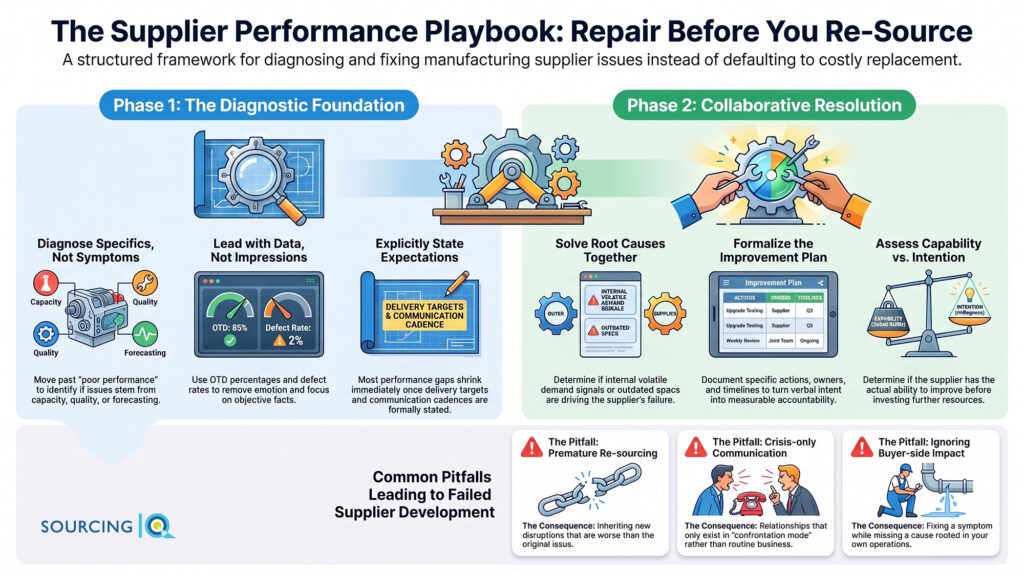
✓ Work the Root Cause Together
This is the step most procurement teams skip, and it’s the one that actually fixes things. A supplier struggling with on-time delivery might be reacting to demand signals you didn’t realize were that volatile. A quality issue might trace back to specs that changed three times without anyone formally updating the drawing. Ask directly: what’s actually driving this, on both sides? Performance problems are frequently shared. Treating them as entirely the supplier’s fault usually means you fix the symptom and miss the cause.
✓ Put the Plan in Writing
A good conversation that goes nowhere is just a good conversation. Real improvement needs a written plan: specific actions, who owns them, a timeline, and a way to measure whether it worked. A supplier might commit to scheduling changes or weekly capacity updates. You might commit to better forecasting or clearer specs. Write it down. Review it. That’s what turns intent into accountability.
✓ Decide if This Relationship Is Worth Saving
Not every supplier relationship deserves to be repaired, and pretending otherwise wastes everyone’s time. Is the supplier willing to improve? Do they have the real capability to close the gap, or just the intention? Is this category strategically important enough to justify the investment? Are there realistic alternatives if it doesn’t work? Some suppliers respond to structured development and become better partners than they ever were before. Others don’t have the willingness or the capability, and the honest answer is to move on.
Where This Usually Goes Wrong
Escalating to re-sourcing before anyone’s diagnosed the actual problem. Switching suppliers and inheriting new disruption that’s worse than the original issue. Collecting performance data and never turning it into a conversation. Holding suppliers to expectations that were never communicated. And the one nobody likes to admit: ignoring how much of the problem originated on your side of the table.
Development Is the Capability, Not Just the Measurement
Measuring supplier performance is table stakes. The capability that compounds value is knowing what to do once the scorecard flags a problem. The strongest manufacturing procurement teams diagnose accurately, lead with data instead of assumptions, collaborate on root causes instead of assigning blame, and build improvement plans with real structure behind them. They also know and accept that replacement is sometimes the right call. Just not the first one.
Procurement maturity isn’t proven by how fast you can find a new supplier. It’s proven by how well you develop the ones you already have.